

The Future of Flourishing: A First Look at the Unified WELL Standard
We believe the environments we inhabit should do more than house our daily activities; they should actively support our well-being. This philosophy is why we closely follow the evolution of the WELL Building Standard, the global benchmark for health-centric design.
Recently, the International WELL Building Institute (IWBI) shared a significant milestone: the next version of the WELL Standard is now open for public comment through May 1. This "One WELL" vision is a thoughtful reimagining of how we create, measure, and sustain spaces that put people first.
A Unified Vision for Health
The most significant shift in this update is the move toward a unified, harmonized standard. Previously, different types of projects, from commercial offices to residential spaces, navigated separate frameworks. The new preview consolidates these into a single cohesive system.
This "One WELL" approach ensures that whether we design a private sanctuary or a community hub, the core principles of human health remain consistent and accessible. It’s a more intuitive way to look at the building blocks of wellness, making it easier for designers and inhabitants to understand how a space supports them.

What is Changing?
While the rigorous, evidence-based strategies that define WELL remain the foundation, the way we interact with them is becoming more streamlined. Key updates in this preview:
Integrated Ratings and Certification: In a shift that honors every effort made toward health, the new structure ensures that "every step forward counts." Points earned toward specific health, safety, or equity ratings now count toward full WELL Certification.
Thematic Groupings: Strategies are now organized into intuitive themes. This allows design teams to pinpoint goals, such as mental health support or restorative lighting, with greater precision.
Clearer, Global Language: The requirements have been rewritten to be clearer and more scannable. This shift away from dense technical jargon makes the standard more adaptable across global markets and easier for homeowners and business owners to implement with confidence.
Rewarding Progress: Preconditions, the mandatory baseline requirements, will now qualify for points across the board. This recognizes the value of these fundamental health features and rewards projects for their commitment to baseline excellence.

Designing for the Whole Person
At its heart, the evolution of the WELL Standard is about making "people-first places" the norm rather than the exception. By refining the concepts we've championed, like air, light, mind, and community, this update makes it simpler to weave wellness into the fabric of a building.
For example, the updated standard continues to prioritize:
Restorative Spaces: Creating opportunities for quiet reflection and connection to nature to mitigate daily stress.
Environmental Quality: Ensuring the invisible elements, the air we breathe and the water we drink, are held to the highest purity standards.
Inclusive Design: Expanding the community concept to ensure spaces are equitable, accessible, and welcoming to all, regardless of physical abilities or backgrounds.

Why Your Voice Matters
The IWBI is seeking feedback from the community of designers, architects, and occupants who live and work in these spaces. The public comment period is an opportunity to ensure the standard remains practical and impactful for real-world application.
By participating in this process, we contribute to a future where our buildings are tools for longevity and joy. As this new version moves from preview to final release, it promises to make the journey toward a healthier home or workplace more efficient and rewarding.
Sarah Barnard, WELL AP + LEED AP, is a leading interior designer of personalized, sustainable spaces that support mental, physical, and emotional wellbeing. She creates highly personalized, restorative spaces that are deeply connected to art and the preservation of the environment. An advocate for consciousness, inclusivity, and compassion in the creative process, Sarah has appeared in Architectural Digest, Elle Décor, Vogue, HGTV, and many other publications. Sarah was honored as a “Ones to Watch” Scholar by the American Society of Interior Designers (ASID).
References & Further Reading
For those interested in the rigorous science and evolving frameworks behind the One WELL vision, the following resources provide the foundational data and official guidelines used to develop these health-centric strategies:
Primary Sources
International WELL Building Institute (2026). The WELL Building Standard: Concept Directory. An overview of the eleven core categories of human health in the built environment.
International WELL Building Institute (2026). One WELL: A Unified Vision for the Future of Health. Official announcement regarding the harmonization of WELL programs and the public comment period.
IWBI Public Comment Portal (2026). Standard Preview and Feedback Forum. The active platform for reviewing side-by-side comparisons of v2 and the upcoming enhancements (Open through May 1, 2026).
Foundational Research
Allen, J. G., & Macomber, J. D. (2020). Healthy Buildings: How Indoor Spaces Drive Performance and Productivity. Harvard University Press. A key text often cited by IWBI regarding the economic and cognitive benefits of healthy offices.
World Health Organization (WHO). Guidelines for Indoor Air Quality. The scientific basis for many of the Air and Materials requirements found within the WELL Standard.
Global Wellness Institute. Wellness Architecture & Design Initiative. Research exploring the intersection of the built environment and holistic human health.

Cosmopolitcal Design: A New Modality Harnesses the Connection between Home and Nature

With global society and climate in flux, mapping out new ways to live and create in the world has become an essential project. Amid the competing approaches to this transformation, the philosophical school of cosmopolitics, as its name suggests, addresses this challenge in a uniquely holistic way and presents an entirely new perspective on the human relationship with the world.
Albena Yaneva, in her introduction to What is Cosmopolitical Design?: Design, Nature, and the Built Environment, explains that “Cosmopolitical thinkers...see nature as no longer being unified enough to provide a stabilizing pattern for the experience of humans; it is not ‘out there,’ a simple backdrop for human activities.” Cosmopolitics distinguishes itself from cosmopolitanism by positing a relationship with nature and its non-human denizens defined by cohabitation rather than dominance. As Yaneva writes, “These thinkers abandon the modernist idea of nature as being external to the human experience—a nature that can be mastered by engineers and scientists from outside.”

How does this cosmopolitical perspective manifest in the world of home design? To Yaneva, “It challenges design...to encourage the enactment of new relationships both within and potentially outside the designed space.” Cosmopolitical home design is deeply tied to its locality and integrated with its environment. Yaneva describes cosmopolitical design as “required more than ever to address the primordial question of what it means to live together. That is, the co-existence of humans and non-humans, of how they share space and find ways to live together in peace.”
Because the cosmopolitical way of thinking is so all-encompassing, the approaches to incorporating cosmopolitics into home design are fittingly varied and can be scaled to projects as vast as urban planning or as circumscribed as landscaping a backyard. Manifestations of cosmopolitical home design can range from home renovation with the local climate in mind (for example, placing windows for optimal warmth or cooling of interior spaces) to pollinator-friendly gardens teeming with plants indigenous to their region.

To interior designer Sarah Barnard, WELL AP + LEED AP, bringing cosmopolitics into her home design practice means cultivating spaces that are specific both to her clients and as well as to the local environment and that encourage an accord with the natural world. Sarah says, “Finding ways to harmonize the design of a space to a specific environment instead of working against it is both challenging and rewarding. When a designed space and its greater environment are fully integrated, the effect is almost easier to feel than observe.”
Sarah explains, “I always look for opportunities to create inviting connections between the indoors and the outdoors. This continuity with the natural world is beneficial for emotional and mental health—it’s not just a source of beauty but nourishment.” For an artist’s bungalow, Sarah created a visual continuity between lush indoor plant life and the garden outside, and then took it a step further. Sarah designed the outdoor garden to support pollinators, birds, and other wildlife. The garden is a Certified Monarch Waystation, providing resources to support migrating Monarch butterflies by providing food, water, cover. Sarah said, “Designing homes for wellbeing doesn’t have to stop at the comfort of the client. Incorporating elements of design that nurture the local ecology deepen our relationship with nature and result in spaces that are unified with their surroundings.”

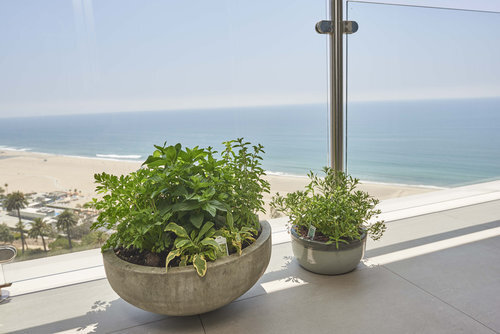
This particular expression of cosmopolitical home design can be achieved even with limited outdoor space. For an oceanview penthouse, Sarah transformed a balcony into an inviting habitat for local and migrating wildlife by adding potted olive trees and an herb garden. “Considering plants not just for their decorative beauty but also what they can offer to the local environment is a concept that works on virtually any scale,” Sarah says. To decorate the interiors, Sarah selected natural and eco-friendly furnishings and textiles, adding that “Organic materials have a gentler environmental impact, and from a wellness perspective, are kinder to the people who live with them.”

When selecting materials and furnishings for home decorating, Sarah often looks to her clients’ priorities to guide her approach to creating spaces that embody a cosmopolitical perspective. For one high-rise suite, the owner’s love of animals was demonstrated not only through the choice of art and decorative objects, but also wanted this care toward animals extended outside home design and beyond aesthetics. Sarah addressed this by using exclusively vegan materials and furnishings for this project. Sarah explains, “No space exists in a vacuum—every object and material we use has a footprint that goes well beyond the front door, so considering the story of the materials we use and the impact that they have on the world is a way to invite cosmopolitical ideas into home design.”

Sustainable materials can also have unexpected origins. For the kitchen of a historic craftsman bungalow, Sarah installed a countertop made of recycled beer bottles, a non-extractive alternative to a more traditional quarried stone countertop. “Not only is the material beautiful and environmentally conscious, but there’s also a little whimsy in how it reinvents something ordinary and adds character to the space,” Sarah says. The implications behind cosmopolitical home design may be weighty, but there is always room for playfulness.

“When I look at my work from a cosmopolitical perspective,” says Sarah, “I see tremendous opportunity for creativity. We are seeing our way of life change in real-time, and as a home designer, I’m lucky to be able to be a part of facilitating that transformation for my clients.”

Sarah Barnard is a WELL and LEED accredited designer and creator of environments that support mental, physical and emotional wellbeing. She creates highly personalized, restorative spaces that are deeply connected to art and the preservation of the environment. An advocate for consciousness, inclusivity, and compassion in the creative process, Sarah’s work has been recognized by Architectural Digest, Elle Décor, Real Simple, HGTV and many other publications. Sarah was recognized as a “Ones to Watch” Scholar by the American Society of Interior Designers (ASID).

The Healing Power of Home: Sustaining and Nourishing our Bodies and Minds

CUSTOM KITCHEN DESIGN BY SARAH BARNARD, PHOTO BY STEVEN DEWALL.
As we collectively navigate this new way of living, I am thinking of you and your family and wishing wellness and security. With so many unknowns, I am grateful for the sureness of a community that uplifts with compassion, resilience, and ingenuity, and offers inspiration to forge forward.
During a time when our world feels new and uncertain, our studio is drawing on the core foundational beliefs and principles behind our approach to home design. We create spaces that support health, emotional security, and wellness, that is the bedrock of our work. These ideals go beyond our creative process and into our working methods of designing homes. As a studio, we are building upon many of the systems we've previously had in place.

BESPOKE AMERICAN WALNUT KITCHEN CABINETS PAIRED WITH HANDMADE CERAMIC TILES BY CALIFORNIA BASED ARTISANS. INTERIOR DESIGN BY SARAH BARNARD, WELL AP + LEED AP. PHOTO BY STEVEN DEWALL.
Our studio has always aimed to work with local artisans and craftspeople when possible, and value these relationships now more than ever. Many supply chains are experiencing disruptions throughout the home design industry. We are working together with trusted vendors to source materials and find creative solutions during this difficult time.
In our homes, this time has offered an opportunity to examine our routines, and to look at our needs. Health, functionality, and wellbeing informed our process before the spread of COVID-19, and these factors are more crucial than ever as we continue to build supportive spaces for you and your family through mindful home design.

INTERIOR DESIGN BY SARAH BARNARD, PHOTO BY STEVEN DEWALL.
Many of us are facing challenges in caring for our loved ones, evolving and uncertain circumstances with work, homeschooling children, and maintaining our physical and emotional wellbeing. In addressing these struggles, we are turning to our homes for solutions, realizing more than ever the need for multi-functional and high performing living spaces.
Our regular team meetings are an opportunity for the studio to brainstorm and problem solve collectively, and recent conversations frequently turn to personal solutions for managing this time at home. We wish to extend this conversation to our community and clients and offer some of our favorite approaches for adapting our home design to these changing times.

COLORS INSPIRED BY NATURE CREATE THE PALETTE FOR THIS TRADITIONAL HOME. INTERIOR DESIGN BY SARAH BARNARD, PHOTO BY STEVEN DEWALL.
HOME HEALING QUICK TIPS
Structure your spaces for ease of movement, connectivity, and peace of mind. Move your workspace in front of your favorite exterior view.
Open your windows and cross-ventilate your home any day weather permits to improve indoor air quality and enjoy the mood-lifting benefits of watching birds and butterflies.
Scoot your coffee table to the side for extra room to play and exercise, and set it up with floor pillows for a new homework station for children.
Move your favorite painting to the room where you spend the most time, whether it's a home office, kitchen, or nursery, and enjoy the beauty and transcendence of art.
Use your occasion dishes more often, and if you're spending more time than you'd like inside the kitchen, bring your cutting board to the back yard.
Think about how your home is supporting your physical health and invest in materials that benefit indoor air quality. Be mindful when bringing new items in your home, avoid air fresheners, and fill vases with aromatic mint and rosemary.
Make sure your bedroom is supporting your sleep habits by clearing out clutter and adjusting lighting to meet your needs.
Carve out time with nature, even if it is tending to a favorite indoor plant or watching hummingbirds in your garden.

Be resourceful, get creative, trust your instincts, and listen to what your mind and body needs, and mold your home to fulfill those needs. And you can always call us if you need some ideas. Our studio and local craftspersons are here to serve.
While we discover methods to care for ourselves, we have learned the necessity and power of turning to others for support and assistance. We offer our support by helping create functional homes so that your safe place is also your ideal space.
We hope that this time to reassess, rearrange, and reconnect, can carry us into a healthier and more positive future, supported by homes that sustain and nourish our bodies and minds.

Sarah Barnard, WELL AP, and LEED AP designs healthy, happy, personalized spaces that connect deeply to nature and art. Empathy and mindfulness are the foundation of her practice creating healing, supportive environments that enhance life.

Award Winning Los Angeles Interior Designer Achieves WELL Accreditation
Interior designer and Leadership in Energy and Environmental Design Accredited Professional (LEED AP), Sarah Barnard of Sarah Barnard Design has recently achieved recognition from the International WELL Building Institute (IWBI) as a WELL® Accredited Professional. The WELL Building Standard® is the premier standard for buildings, interior spaces and communities seeking to implement, validate and measure features that support and advance human health and wellness.


WELL was developed by integrating scientific and medical research on environmental health, behavioral factors, health outcomes and demographic risk factors that affect health with leading practices in building design and management. WELL Certification and the WELL AP credentialing program are third-party administered through IWBI’s collaboration with Green Business Certification Inc. (GBCI), which also administers LEED certification, the global green building program, and the LEED professional credentialing program. This relationship assures that WELL works seamlessly with LEED.

Sarah Barnard Design was established in 2003 with a focus on creating spaces that are respectful of history, healthy, art-forward, and deeply connected to nature. Sarah was LEED accredited in 2007 and WELL accredited in 2017. Some of her notable projects include the National Immigration Law Center, Heritage Square Museum, National Geographic Entertainment, and numerous beautiful residences.


Barnard was recently recognized as an American Society of Interior Designers (ASID) National Ones to Watch Scholar, was featured in the July 2017 Issue of Metropolis Magazine and is scheduled to guest lecture at the 2018 ASID National Student Summit, SCALE in Los Angeles, CA.
Sarah Barnard designs healthy, happy, personalized spaces that are deeply connected to nature and art.
To learn more about Sarah Barnard Design, please visit www.SarahBarnard.com.
For more information about WELL https://www.wellcertified.com/en