


Beyond Order: Restorative Storage in Modern Design

A common philosophy of storage and organization starts with a period of purging, usually involving a rigid keep, donate, or trash approach. However, this process does not always acknowledge the emotional value of our possessions or fully consider how someone wants to live and feel in their home from a psychological standpoint.
“A common approach to organization often prioritizes elimination, yet it frequently fails to acknowledge the profound emotional resonance of the objects we choose to surround ourselves with,” says Sarah Barnard, WELL and LEED accredited interior designer. “Restorative design is not about what we can discard, but about how we can curate an environment that supports our emotional well-being and reflects our true intentions for how we wish to inhabit a space.”
Many homeowners need a more nuanced strategy that allows for emotion, uncertainty, and changing capacities. The traditional sorting pile is a helpful visual tool, but the criteria for what remains should be personal and reflect one's own history. It is essential to recognize how objects hold meaning, serving as cherished mementos, touchstones, or evolving pieces of a larger collection. If the home is a safe space for free expression, much-loved items play a vital role in self-expression and daily joy.

The Psychology of Curation
Organizing still benefits from a structured process, but the mindset should be rooted in the positive. “Sorting should be approached as an act of self-care rather than a chore of elimination,” Barnard notes. “Instead of asking what we can live without, we should ask how we want our home to support our mood and the daily rituals that bring us comfort.”
By using a feelings-first guide, homeowners can look beyond strict utility. While function is a common starting point, the emotional goal of a room is just as significant. An object might be functional and valued for its usability, or valued simply because it is beautiful. In high-end design, beauty is often a primary function, contributing to calm and visual delight. For many, collecting and curating is the source of joy itself. In these cases, the process is about honoring the collection rather than reducing it.
Managing Sentimental Thresholds
Sentimental items often need a different timeline. A memory box preserves items linked to a person, place, or thing without requiring an immediate decision on their permanent place. This gives time to assess the sentimental reasons for keeping or sorting objects. Items that offer tactile comfort, such as favorite textiles or calming-colored objects, should be seen and kept as sensory anchors at home.
For objects that trigger uncertainty, a holding strategy can help. It can be hard to make quick decisions about inherited pieces or items with complex histories. Placing these in a designated area for review gives time and control. The key is to set a plan to revisit the collection. This ensures the holding area is a temporary pause, not a source of hidden stress.

Architectural Systems for Restorative Living
Once curation is complete, focus shifts to systems to encourage a seamless daily experience. A sophisticated home needs a balance of open and closed storage. Open shelving or rails provide access to frequently used items and serve as display platforms. To prevent visual overload, pair these with closed cabinetry or integrated millwork.
In a home office, this might manifest as an elegant display shelf for books and art, paired with concealed filing or cabinetry for administrative essentials. In the kitchen, high-touch tools may remain on a beautiful tray on the counter, while secondary appliances are tucked into specialized drawers. For items that carry deep meaning but lack a functional place in the current layout, digital preservation is a thoughtful alternative. Scanning precious items like children’s art or archival correspondence keeps the memories accessible while reclaiming physical space for new experiences.
Intentional Visibility and Ease
Achieving a balance of visibility without overload is personal. While concealing belongings may lead to their eventual neglect, maintaining total visibility can inadvertently lead to sensory overload. Subtle storage tools can help strike this balance. Shallow trays, baskets, or pull-out shelves in larger cabinets prevent items from becoming buried. Clear or semi-clear bins in closed closets maintain order and allow for quick identification.
Functionality means different things for everyone, and the goal of a sophisticated organizational system is to enhance the user's experience by creating an environment that feels intentional, paced, and restorative. By moving beyond the pressure of order for order’s sake, the modern home transcends simple organization to become a landscape deeply aligned with the lives lived within its walls.
Sarah Barnard is a WELL and LEED accredited interior designer and creator of environments that support mental, physical, and emotional wellbeing. She creates highly personalized, restorative spaces that are deeply connected to art and the preservation of the environment. A certified California Naturalist, Sarah believes in celebrating nature through responsible design that works symbiotically with the local environment.
An advocate for consciousness, inclusivity, and compassion in the creative process, Sarah has appeared in Architectural Digest, Elle Décor, Vogue, HGTV, and many other publications. Sarah was recognized as a "Ones to Watch" Scholar by the American Society of Interior Designers (ASID) and has been awarded "Best of Houzz Design" for seven consecutive years. Sarah's MFA in visual arts from Claremont Graduate University informs her practice and innovative approach toward interior design as creating a living work of art.

Unpacking the “KonMari” trend: The personalization of ultra-home organizing

A TIDY, MINIMALIST KITCHEN IN WITH OPEN SHELVING TO KEEP COOKBOOKS CLOSE AT HAND.
Before Marie Kondo, there was William Morris, a renowned 19th-century British designer who lived by this philosophy: “Have nothing in your house that you do not know to be useful or believe to be beautiful.”
Kondo has a more stringent and less personalized approach. She encourages followers of her KonMari method to grasp each item in their hands and evaluate their body’s reaction to it. If it makes you feel uplifted, put it in the keep pile. If it causes you to feel weighed down, in the donation bin it goes. But here’s the thing — there’s no one-size-fits-all organizing method. Whether you prefer a pragmatic approach à la William Morris or Kondo’s emotionally-guided decision-making process, figuring out what works for you and your lifestyle is paramount.

FLOATING SHELVES PROVIDE VERTICAL STORAGE IN THIS COMPACT HOME OFFICE FEATURING AN IMPRESSIVE VIEW OF THE SHORELINE.
“The method of organization should support the client’s daily routine and activities,” says interior designer Sarah Barnard, who specializes in healthy, happy, personalized spaces. “What items do they use most regularly? How do they envision the space? Having a clear goal will start to inform the plan.”
Barnard provides organizing services for clients in every stage of life, from young professionals with little spare time to retirees with reduced mobility. “One of the main reasons people ask for our help is because they are overwhelmed and don’t know where to start,” explains Sarah. “Our goal is to streamline the process by setting up personalized systems that can be easily maintained.”

A TIDY STUDIO BOOKCASE KEEPS FAVORITE BOOKS CLOSE AT HAND. A PAINTING BY ABBY SIN, SCULPTURE, CERAMICS AND ANTIQUES LIGHTEN AND BRIGHTEN THE DISPLAY.
Sarah recently tackled a two-week-long organizing project for a busy family of five. Recognizing that the experience can be quite invasive, Sarah and her team went to great lengths to ensure the family felt comfortable. Shoe covers were worn to prevent anyone from tracking in allergens, and cotton gloves were required when handling any personal items.

VERY POSSIBLY THE BEST BOYS' BEDROOM EVER! NEWLY BUILT WALLS ALLOW FOR CUSTOM-MADE AMERICAN WALNUT BUNK BEDS AND FLOATING DESKS FOR EACH BOY.
Clearing away unnecessary clutter was the family’s aim, and Sarah’s team employed the ‘keep, toss, donate’ method to get it all done. “We sorted our client’s clothing by season, removing the winter wear and storing it in the hallway closet,” says Sarah. “Now, primary closets contain only half the amount of items, making them more spacious and easier to navigate.”

PERSONALIZED TOOLS FOR STAYING ORGANIZED! EACH BOY'S DESK INCLUDES A UTILITY WALL WITH A CHALKBOARD, PIN BOARD, METAL PANEL FOR MAGNETS AND WIPE OFF BOARD CALENDAR.
In addition to freeing up closet space in the home, Sarah Barnard Design took on the organizing of a child’s craft room. “The client’s youngest son had received arts and craft gifts for each holiday of his young life,” notes Sarah. “This resulted in a wonderful collection, but also a lot of bits and pieces— to the point where the craft room was largely unusable.” The team carefully combed through his many art supplies, donating lesser-used items to create space for the most cherished ones.
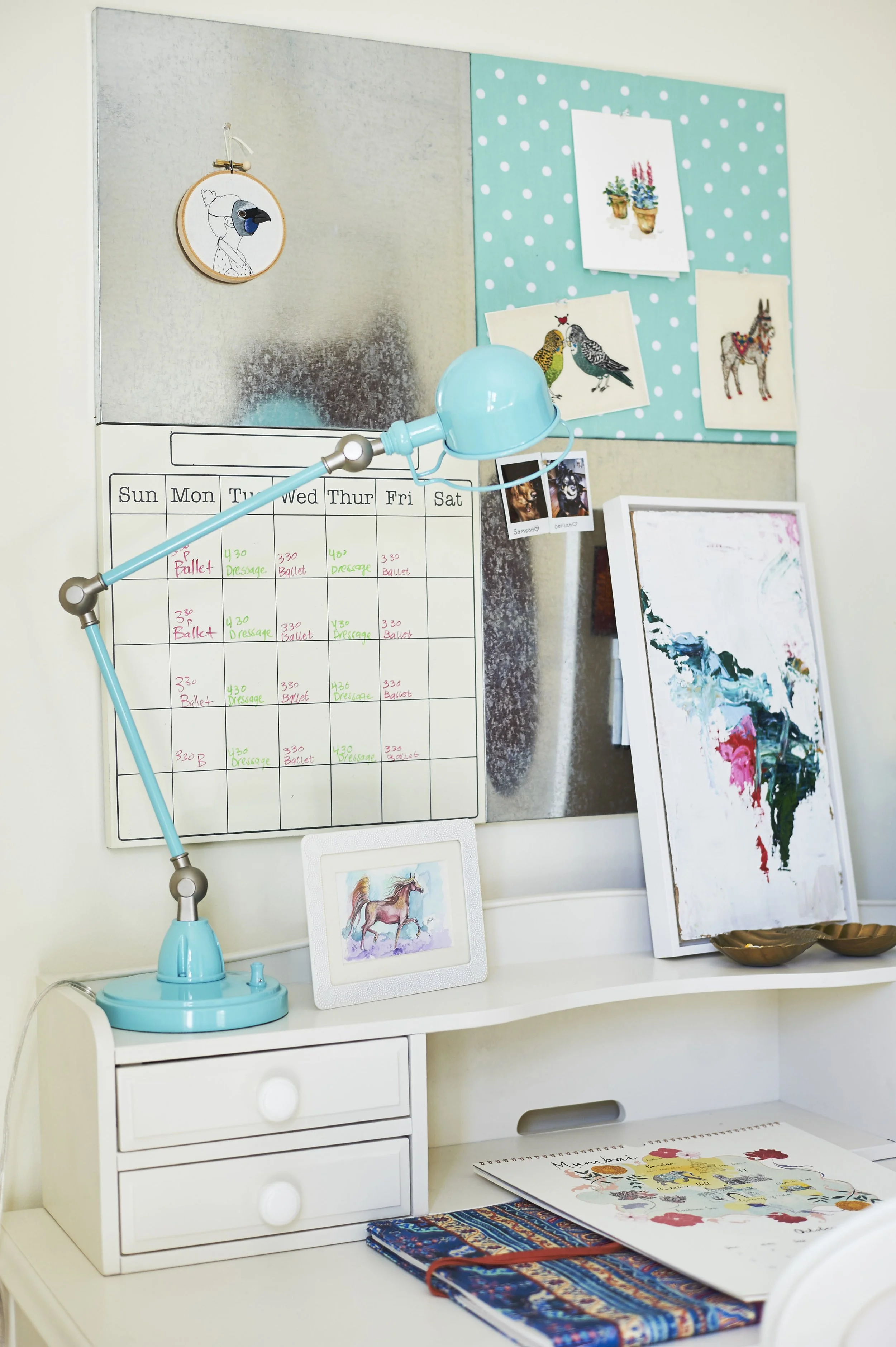
AN ARTICULATING DESK LAMP ADDS A POP OF AQUA TO THE TEEN GIRL'S STUDY AREA.
Once an organizing project is complete, Sarah’s clients have a renewed sense of self. Decluttering is a lifestyle change, but the benefits are well worth the effort. “It often inspires a newfound appreciation for their possessions and increased productivity in the space,” says Sarah.

A CREATIVE SPACE WITH A CUSTOM SOFA IN WOOL FELT, SIDE TABLES MADE OF NATURAL MAPLE AND STEEL AND A DESK CHAIR DESIGNED BY MAURO LIPPARINI. SCULPTURE BY RENAE BARNARD.
Adopting a personalized approach to organizing will spark far more joy than bingeing an eight-part Netflix series and assuming your tidying habits will change through osmosis. Decluttering is hard, both physically and emotionally — it’s not something that comes naturally to most people. Seeking professional organizing help is an investment in yourself, saving you time, energy, and unnecessary stress. And hiring an expert to create customized systems that fit your lifestyle will help you stay organized in the long-term — no self-help books required.
Sarah Barnard designs healthy, happy, personalized spaces that are deeply connected to nature and art.
To learn more about Sarah Barnard Design, please visit www.SarahBarnard.com.
Photos by Steven Dewall and Chas Metivier