


California Minimalism: Scandifornian Style By the Coast

When a government executive from the east coast decided to retire, she knew it was time to finally make her home by the beach into the perfect restorative retreat. From a lifetime of travel, she collected an eclectic and beautiful array of art and antique furniture that needed to proper placement in the home she bought in the 1990s with her now late husband. She enlisted the help of Sarah Barnard Design to redesign the home, entrusting her with the task of blending the unique and personal pieces of the collection with a healthy, natural and minimalist style. Inspired by the light, bright and natural aesthetic of Scandinavian design, combined with the casual, collected aesthetic of coastal California.
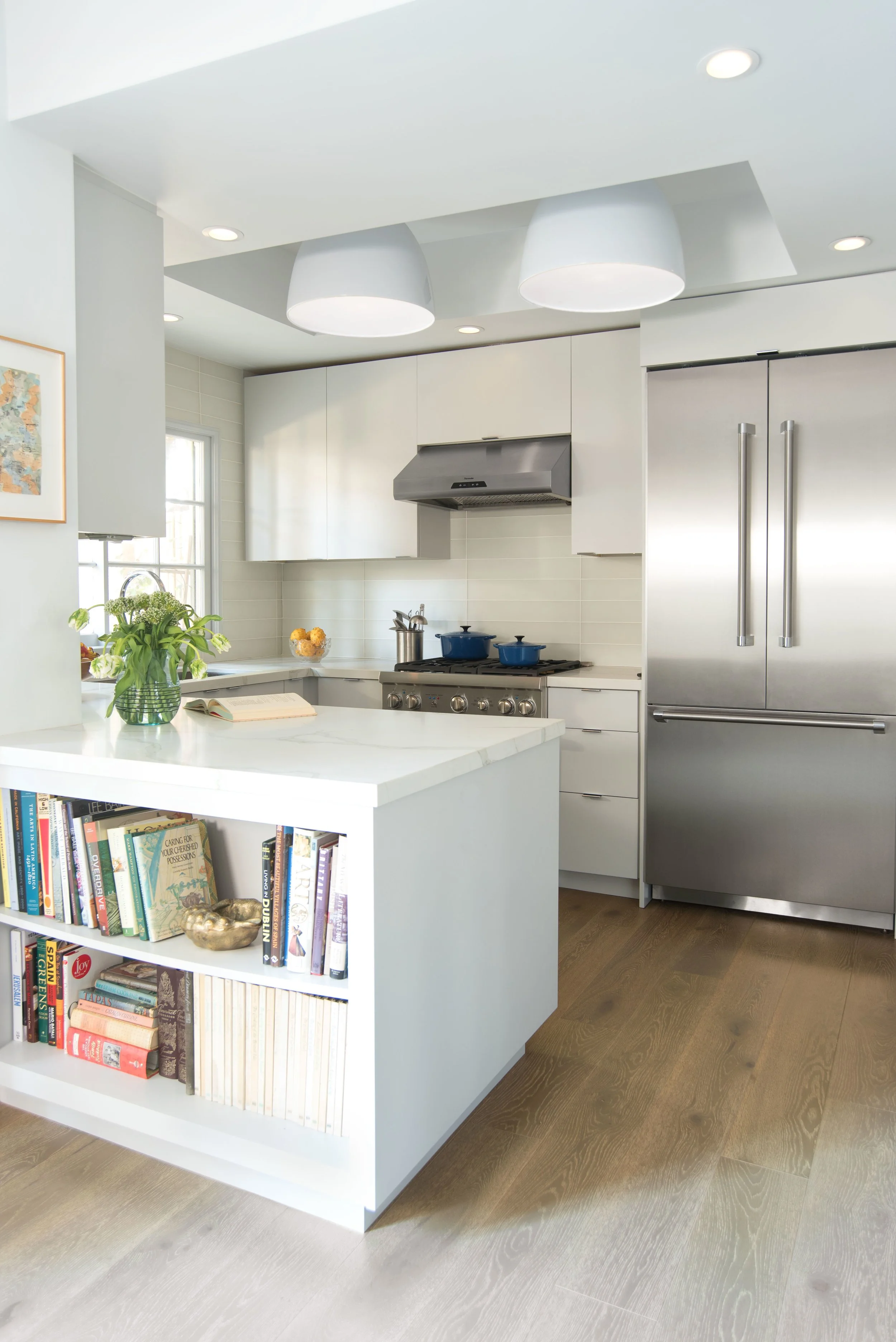
Sarah Barnard set out to create a home that was not only beautiful, but that would allow the owner to be comfortable indefinitely. To achieve form and function in the kitchen, reordering the space to fit the clients’ lifestyle best proved to be the solution. An open-plan design was chosen to allow the owner to quickly cook, as well as to allow for easy entertaining of guests.
Sarah chose pale grey flat panel cabinetry to help the small space feel lighter and brighter. Matte white glass tiles were selected to add a quiet elegance to the minimal space. Once the project was complete, the homeowner gushed, “Entertaining here is much more pleasurable, as is cooking for one in my new kitchen.”

The natural French oak flooring seamlessly connects the kitchen to the dining area, enlarging the sense of space in both rooms. Open shelving just outside the kitchen keeps cookbooks close and adds a sophisticated pop of color while stainless steel appliances were selected to pair with polished chrome cabinet hardware subtly. The simplicity of the color palette, the clean, natural materials, and the streamlined design created simplicity and new ease of use.
Sarah knew that repurposing the owner's treasured pieces would be essential in the home's re-design, so the owner's antique chairs and matching rosewood table from Thailand are placed prominently, bringing warmth and history to the contemporary dining space. The Italian chandelier above it contrasts the classic style and is made of laser cut metal and glass.

In the living room, the original design included a sizeable diagonal bench that connected to the fireplace. The redesign eliminated this and other cumbersome architectural elements to create more floor space and a modern aesthetic. Sarah conceived a more straightforward hearth to feature art and items her client painstakingly collected. A serene white plaster fireplace with a Qortstone marble hearth now anchors the living room in a place where a traditional wood and stone mantle once sat.

“I had not originally contemplated changing the living room fireplace wall, but I am delighted with the sleek new look Sarah achieved,” said the owner, who was also happy to have the perfect place for her paintings finally. “This oil painting, ‘Raspberry,’ previously hung in the stairwell between the second and third floors where its exuberant shapes and brush strokes could not be fully appreciated.” The painting, by Wendy Edwards, now hangs neatly above the fireplace.

A pair of dark stained wood coffee tables, also from the owner’s collection, were carefully chosen to make entertaining easy, while the vintage rug anchors all the white space with vibrant color. The result is sophisticated minimalism throughout the living room.

Upstairs, the owner requested an expansive shower, so the primary bathroom became a "wet room." Sarah planned for every eventuality in the owner's future, including her long term health and well-being using universal design principles. The result was a space free of any barriers like steps or glass shower walls.

Sarah designed the space to feel light and boundless by selecting custom cabinetry, also adding storage and architectural interest to this modern primary bathroom. Plumbing fixtures by California Faucets were chosen for their pure beauty, while the countertop slabs contain small pieces of natural shell, echoing the nearby ocean. Sarah finds that an element of nature adds a touch of calmness. Above the counter, diffuse split disc wall sconces were chosen to add a soft light to the room.

Both beauty and safety are prominent in Sarah’s Scandifornian design. Beautiful and sleek hand-glazed wall tiles inspired by sterling silver accompany durable and slip-resistant porcelain mosaic tile flooring that create a functioning and timeless atmosphere. Finally, an antique Victorian chair and a giclée print by artist D.J. Hall personalizes the fresh and crisp primary bathroom.

While continuing the elegant, sparse aesthetic from the first floor, the primary bedroom suite fills the entire second floor of this beautiful minimal townhouse, so special attention was paid to make it simple and calm. As the owner explained, “I travel frequently, and the serenity of the space makes coming home very comforting.”

The homeowner cares about her health and her environment; she practices self-care through activities like yoga and Pilates. It was essential to her that her home be filled with natural materials. Sarah was careful as always to find organic and lasting materials that would contribute to her health and wellness. The primary bedroom suite now highlights the beauty of natural objects and materials while planning for maximum comfort and use. The space features a vintage leather headboard by Duxiana, and the artwork is a framed print of a painting by Marc Chagall (c. 1957). Glass orbs were chosen to provide soft bedside light that keeps the nightstands free for books and other objects.

A second fireplace in a corner was made over in sterling silver-toned ceramic tiles, adding visual warmth. The marigold club chair beside it was made more personal with the addition of a handmade honey bee pillow embroidered by the homeowner.
Plants and flowers dot the suite, as Sarah adds plants whenever possible to create a healthy and natural environment. The unique collection mixed with healthy materials in the design of this townhouse allowed a meaningful and sophisticated style to emerge. After the completion of this redesign, the owner explained that what she loves best about her new home is “[the] serenity of the color palette and surfaces, the bold, visually arresting scale of the principal lighting fixtures, and the way the new surroundings accommodate favorite furniture pieces and decorative items.” The newly finished home is a testament to the idea that less is more, and that health and natural design are the solutions to luxury.

Sarah Barnard designs healthy, happy, personalized spaces that are deeply connected to nature and art.
To learn more about Sarah Barnard Design, please visit www.SarahBarnard.com.
Photos by Steven Dewall.

Sneak Peek: Pasadena Showcase House for the Arts - 2018

On April 10th, Pasadena Showcase House for the Arts (PSHA) opened its Design Showcase House and Garden for an exclusive press-only preview. Sarah Barnard, an interior designer, and social media influencer, attended the press viewing and captured a sneak peek of the house which opens later this month. While the select group of visitors was allowed to take photos, no guests will be allowed to take pictures or use cell phones once the event officially opens.
This year’s house is entitled “The Overlook,” and is a Mediterranean-style property that includes a primary residence, a guest house, and grounds. Notable architect Reginald Davis Johnson designed the home for two sisters in 1915. Design showcase houses are a home or property where different interior designers are responsible for the design of one room each, and in this case, landscape designers are also given a garden space to transform. The owners of the home generously allow designers to make-over a room, the organization to raise money, and the general public to tour their home for a short time.


Pasadena Showcase House for the Arts, a non-profit, all-volunteer organization, runs this showcase house as a fundraiser for their charity work and welcomes around 25,000 visitors each year. The proceeds PSHA makes off “The Overlook” will go to benefit children’s art programs in Pasadena. They do this in four ways:


“Gifts & Grants: Cumulative donations of more than $23 million have been made in support of outstanding music and arts programs throughout the community. Gifts & Grants are awarded to non-profit organizations for music education, music therapy, underwriting of concerts, etc., as well as continuance of our longstanding support of the Los Angeles Philharmonic Association.
Pasadena Showcase House Youth Concert: Begun in 1953, more than 250,000 fourth grade students have attended this annual free concert designed to weave musical concepts into an appealing program that is presented at the Walt Disney Concert Hall by the Los Angeles Philharmonic Orchestra.
Pasadena Showcase House Music Mobile™: Created by PSHA in 1971 and now produced in partnership with the Pasadena Conservatory of Music, the Music Mobile™ is a hands-on, award-winning program that is presented to third grade students. It provides an introduction to classical music and the opportunity to play a selection of instruments and be part of a simulated orchestra. More than 103,500 students have participated since its inception.
Pasadena Showcase House Instrumental Competition: Since 1984, promising young musicians between the ages of 16-24 have been competing annually for monetary awards in the categories of woodwinds, brass and strings. Nearly $600,000 in prize money has been awarded to assist them in furthering their musical education.”
— PSHA
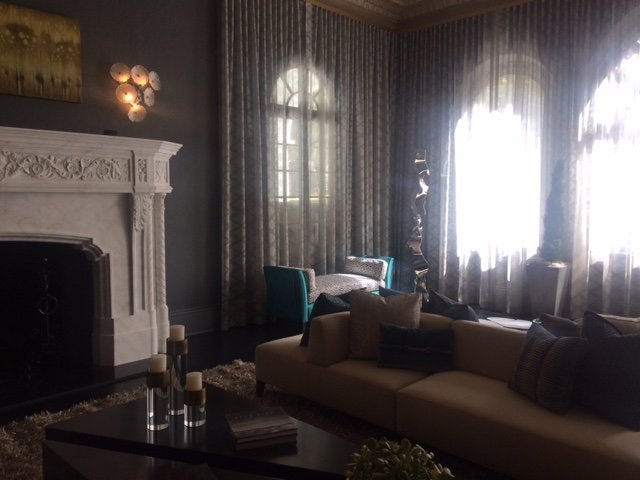
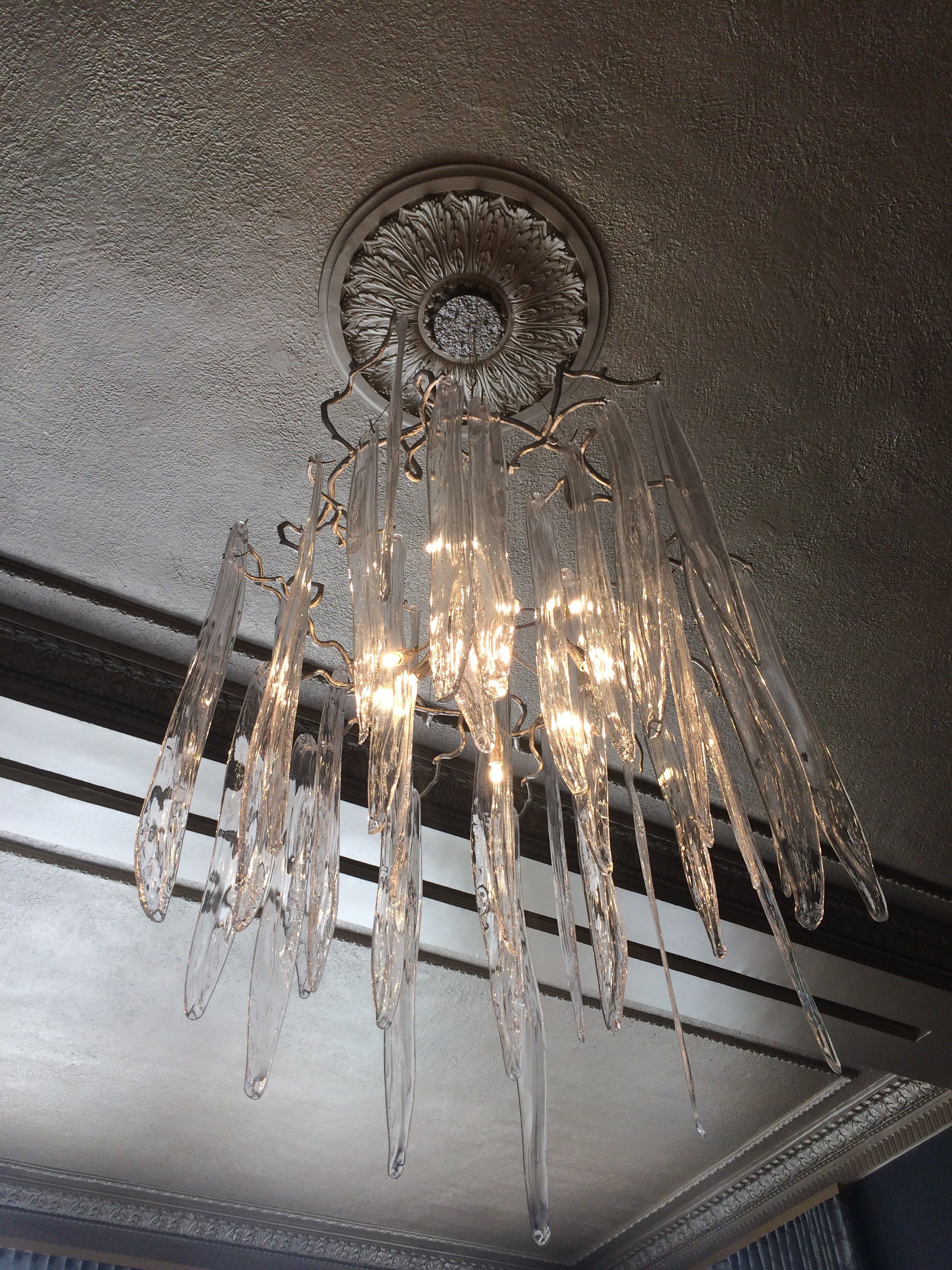
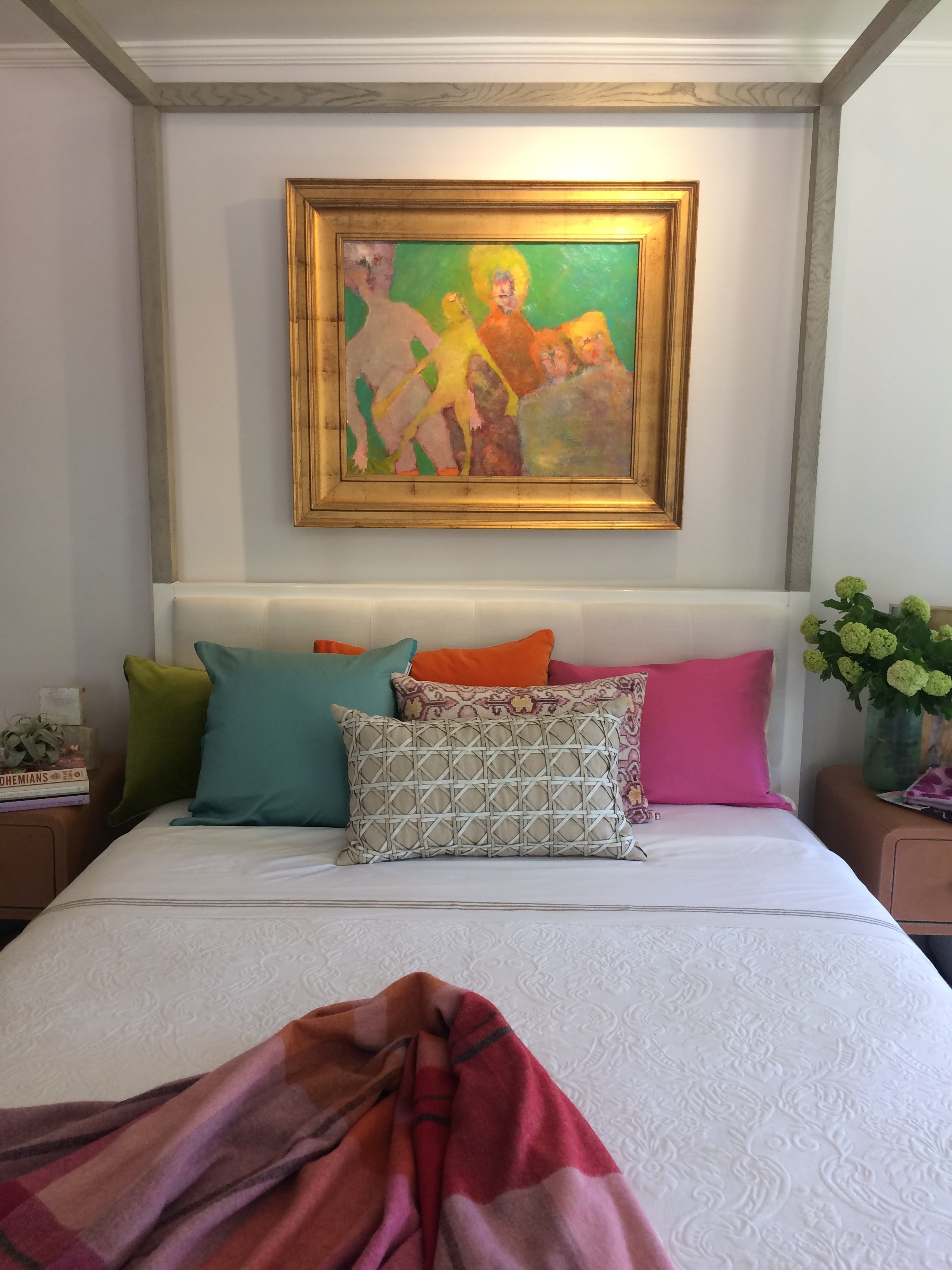
While it still maintains the original Mediterranean atmosphere, the house has contemporary updates made by the homeowners and additions by the showcase designers, culminating in a wonderfully eclectic and surprising home.
Complimentary parking & shuttle services are provided, as the house is in a residential area. The house is open from April 22nd to May 20th, 2018, and tickets range from $35 - $60, depending on times. Tickets can be purchased in advance online at http://www.pasadenashowcase.org/
Designers from all over California come to take part in the making of this project to benefit the community. This year’s crop of designers who generously donated their time and expertise can be found here.
Sarah Barnard designs healthy, happy, personalized spaces that are deeply connected to nature and art.
To learn more about Sarah Barnard Design, please visit www.SarahBarnard.com.
Photos by Sarah Barnard

Biophilia: Nature & Design

You may have seen the terms "biophilia" or "biophilic design" brandished around the internet lately, posted between beautiful images of sprawling home design and architecture filled with plants and nature-inspired sculpture installations. Biophilia isn't new–but it is a growing discipline in home design. If you are interested in healthy living or are a building owner, it's a subject worth learning.
Biophilia is our innate desire to be close to nature–and biophilic design aims to make healthy and comfortable interiors by meaningfully incorporating natural elements into our home and work environments. Los Angeles-based interior designer Sarah Barnard sat down with me to explain how she uses biophilic principles to create healthful, smart spaces for her clients. "It's intuitive when you think about it. Biophilia exists because we are comforted by nature, and we all understand that on some level. Nobody wants to live in a little grey box–we want to live in open spaces connected with the environment, plant-life, and the seasons."

Biophilic design puts a few simple principles to use to create spaces that are both visually beautiful and spiritually healthful. As more and more of us make our careers our focus, calmness, serenity and healthy living can be challenging to achieve without the help of nature and smart design. There are years of study to support what we already know in our bones: spaces that have nature incorporated are more appealing to us, and they have marked health benefits.
Terrapin Bright Green is a consulting firm specializing in sustainability to create a healthy, prosperous, and regenerative future for all. They produce workshops, research, planning, guidelines, and product development. They have researched biophilia and organized their findings into 14 principles of biophilic design and have studied the effects of biophilia on our health and wellness. For the most part, many of the principles are simple and intuitive, such as ‘Visual Connection with Nature,’ which is just what it sounds like: adding natural elements or a view to nature into your space.However if you’d like to read an in-depth, thorough explanation of all 14 principles, you can see the results of Terrapin’s research here: https://www.terrapinbrightgreen.com/reports/14-patterns/ . For today, we need only to talk about the three subcategories of the design principles: Nature in the Space, Natural Analogies, and Nature of the Space.

Nature in the space refers to the presence of natural elements in an interior. For example, that could mean having plants, shells, or water features. But it could also mean more abstract features, like natural light or light that changes throughout the day, air circulation, and a view to the outdoors. “What you exclude is just as important as what you include,” said Barnard. “I choose art made with natural materials or vintage art that has off-gassed to avoid putting noxious smells or chemicals into a space. Indoor air quality accounts for part of how we feel about our homes and how comfortable we are.” All of her designs include live plants, working in tandem with HEPA filtration systems to contribute improved air quality, a non-visual connection with nature.
Natural analogies refers to art and forms inspired by nature: a light fixture that looks like a plant or a sculpture that looks like an animal, for example. A good designer will find natural forms and art for you to choose from so you can have art that imitates nature. Barnard walked me through a project she made custom light fixtures for. “The home was beside the ocean, and I wanted to make something inspired by the beautiful surroundings of that space. I started by sketching forms inspired by coral reefs, and I made miniatures in clay by hand. When they were ready, I had them fabricated by a local craftsman. Having forms that imitated the shape and texture of coral and having light cast in beautiful organic patterns made the space feel natural and serene.”


Nature of the space means making the space itself seem like nature. Having a large open space through which you can see an expanse of space, as well as an enclosed room that feels safe fulfills this need. When asked for an example of how Nature of the Space might be used, Barnard said “I finished a project recently where the space had floor-to-ceiling windows with a view to the ocean. I selected low profile furniture to preserve the open space of the room and the sightline to the sea.”

Terrapin also explains that there are three basic types of “nature-health” relationships: cognitive functionality and performance, psychological health and well-being, and physiological health and well-being. Cognitive functionality and performance is our mental acuity and focus. Psychological health and well-being refers to our mood, perception, and emotional state. Physiological health and well-being is our bodily health and performance.
All three areas of well-being see improvement when the 14 principles of biophilic design are applied in a space. The benefits have been thoroughly studied: each principle has been individually tested and shown improvements such as concentration, stress hormone levels, overall happiness, and numerous other positive effects.

In fact, research by other sources has yielded similar results. The Human Spaces Global Report also found greater levels of well being in subjects with a view of natural elements rather than urban settings, according to a recent article by Steelcase’s magazine 360.
Steelcase, the largest furniture manufacturer in the world, is dedicated to sustainability, innovation, and wellness. They too have invested into researching biophilia in order to produce furniture for healthy, sustainable spaces. They describe the human experience with nature in four categories:
Sensory richness: mixing colors, textures, sizes and shapes. Varied elements in a space mimics nature and puts us at ease.
Natural rhythms and signals: anything that reminds us of natural processes can help restore us. Natural lighting that allows real sunlight, or artificial light that changes to mimic natural light.

Challenges in nature: the idea is that our challenging environment is what pushed humanity to grow into what we are today, so there should be encouragement towards effort.
Local distinctiveness: having a feature that does not repeat anywhere else in the building can help large offices from becoming soulless or bleak. Reserving a certain material or color for one room can make it and the surrounding space more special and pleasant.
These four principles are a useful way to understand how we are affected by nature, and offer another way to begin tackling the design challenges you may be facing in your home or workspace. Whether you use these four facets or the 14 principles of biophilic design as a jumping off point to improve your space, a deeper connection with nature is healthy and beneficial.
“When you strip it down to basics, using biophilic design means including pieces of nature in the design, elements inspired by nature, and mimicking natural environments with layout, architecture and planning,” Barnard said. Homeowners and building owners especially might consider taking these premises into account in order to make their home or office a place that promotes their mental and physical wellbeing. Getting started can be as simple as purchasing a few plants. If you aren’t sure where to go from there, a designer can help you put all the principles into practice. Ideally, your space incorporates nature, smart design and healthy living.
Photos by Chas Metivier and Steven DeWall
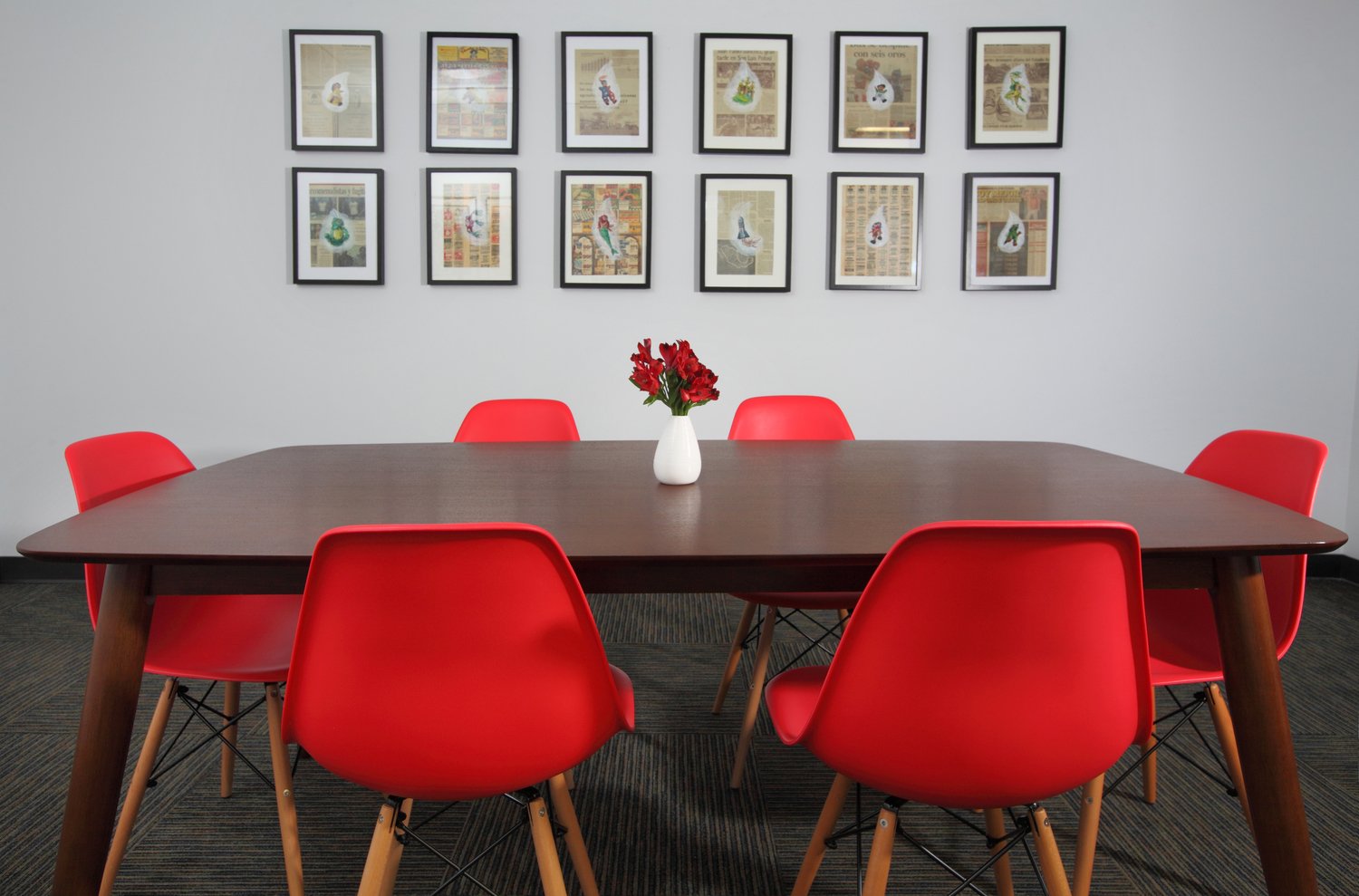
Sarah Barnard designs healthy, happy, personalized spaces that are deeply connected to nature and art.
To learn more about Sarah Barnard Design, please visit www.SarahBarnard.com.

Beachy Bachelor: Masculine Interior Design With a Coastal Influence

For this Beachy Bachelor, Sarah Barnard introduced a mid-century vintage character with a beautiful collection of modern pottery, driftwood, and vintage ceramic vases. This oceanside townhouse embodies the coastal California luxury lifestyle, effortlessly combining opulent materials with a relaxed beach-side setting.


A custom calacatta gold marble bar expands the living rooms entertaining space, while the natural wool rug anchors the conversation area. The floating American walnut console keeps the masculine space light. A reclaimed Elm wood side table rests atop the home's original Oak floors. Crisp, white walls accentuate the natural wood finishes throughout while allowing the minimalist stair-railing to float in space.


The masculine dining room and adjacent patio make the most of their indoor-outdoor connection with a versatile area rug specially selected to withstand the bright light and high traffic. A sculptured glass and steel chandelier reflects the natural light of the surrounding space.
Handmade roman shades attach to a custom wood enclosure for privacy and shade on the patio. A natural teak root ball fashioned into a rugged side table pairs with a weathered teak armchair and lightweight concrete pottery. Acacia wood deck tiles add a warm angular base to the cool blue patio space. Found in Georgia by Sarah, the vintage mid-century modern whale ashtray is brass and a perfect complement to the cool tones.

The primary retreat features a handmade bed of tweed by Domonique Keiffer from Venice, Italy is covered in Belgian linens and shaded by wool draperies. A bold, abstract painting by Jonathan Elder hangs above the bed. Surf-inspired artifacts and unique vintage pieces complete the look.


A vintage leather chair with its original leather patina, designed by Percival Lafer, manufactured in Brazil in 1958. Sarah worked with her longtime collaborator, artist Reid Winfrey, placing several of his surf-inspired paintings in the beachside home.
Sarah Barnard designs healthy, happy, personalized spaces that are deeply connected to nature and art.
To learn more about Sarah Barnard Design, please visit www.SarahBarnard.com.

Pantone's Color of the Year is Ultraviolet... How are You Using It?

A QUICK SNAPSHOT FROM SARAH BARNARD DESIGN'S OFFICE LATE LAST YEAR.
Ultraviolet, an intense and bold shade of purple, is suggestive of the cosmos and the future, while still reminiscent of royalty, wealth, and creativity. It's also Pantone's color of the year. Pantone, the global authority on accurate color matching, is known worldwide for its standard color language which allows designers, manufacturers, retailers, and consumers to accurately produce the same colors across platforms and industries. (If you're not familiar with Pantone, you may have seen their swatch books or their line in Sephora!) They research style trends in art, fashion, and design, and predict the upcoming year's most popular trends.
This year they've selected ultraviolet as their "Color of the Year," so if you were waiting for the opportunity to make a bold change in your home design, it has arrived!

“In interiors, Ultra Violet can transform a room into one of extraordinary self-expression, or conversely its polish can tone down a room with subdued, modern pairings. Adding spice and brightness, Ultra Violet calls attention to a tufted couch, piece of art, or accent wall. As a color that can take you in so many directions, Ultra Violet makes a statement in any space, whether it’s one of tradition and elegance or unexpected boldness. In hospitality, we are seeing purples like Ultra Violet take center stage in interior spaces as large and small hotels harness color and design to entice travelers and stay relevant.”
— Pantone
Trends go in and out of fashion–unless you already love ultraviolet and had plans to use it, it may not be a good idea to paint your whole house purple. However, there are many ways you can feature violet and freshen your home or office, such as adding a bold color in through plants, linens, or art, which will allow you to animate the space in a way that won’t be out of style by the end of the year.
Let’s take a look at some of our favorite design strategies and items in ultraviolet and purple:

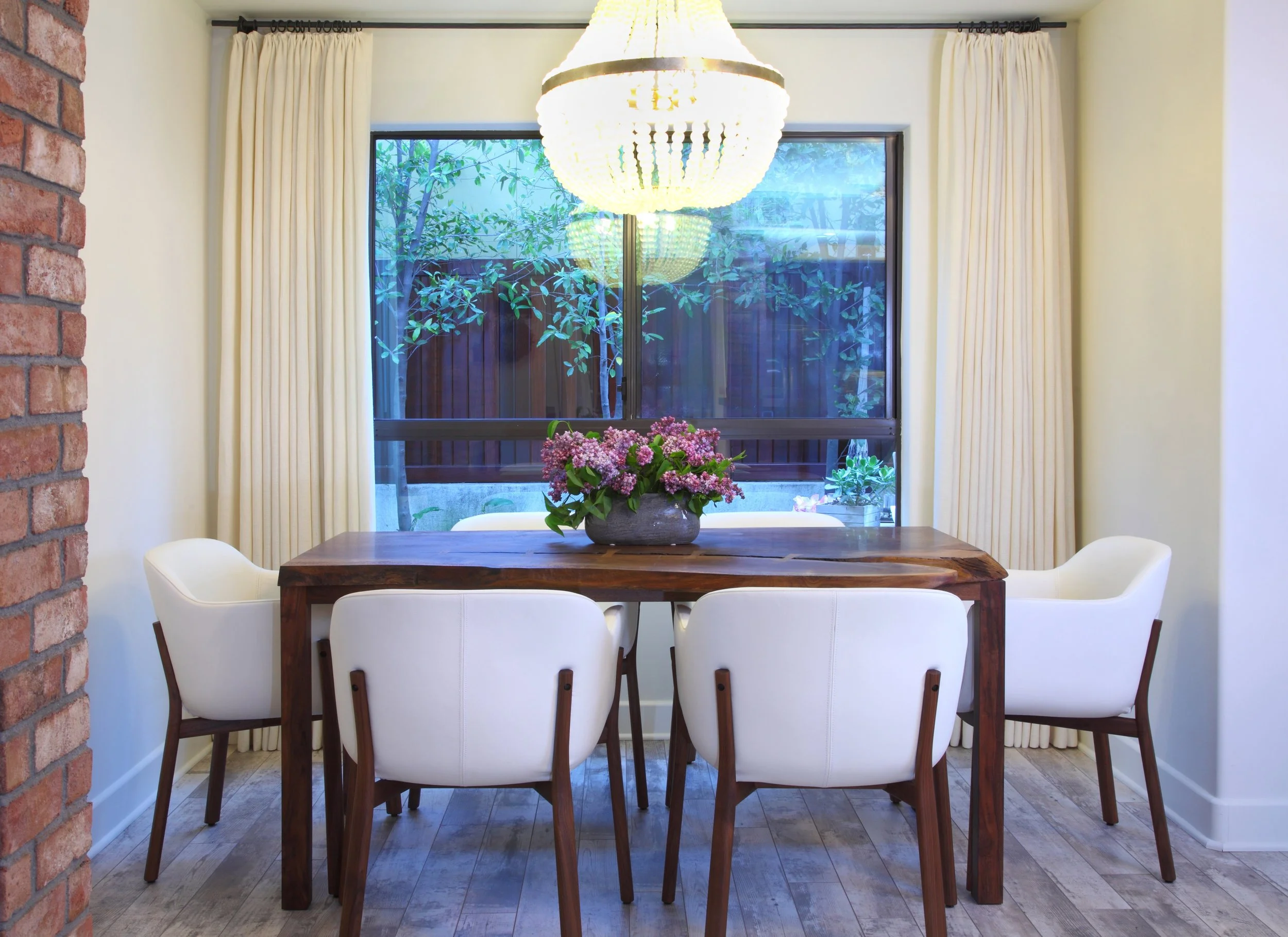
While some might relish the opportunity to use this news as an excuse to paint their entire house violet, most people will find ultraviolet to be an intimidating color with which to decorate. So how might you use it? Consider bringing in a small splash of violet. Flowers, for example, are a beautiful, healthy way to add a pop of bold color that will not be out of fashion in a year.

Adding art to your walls is a fantastic way to add color and interest to a space. This piece by Renae Barnard has swirling shades of violet, blue and pink. An elegant art installation like this will never go out of style.


Lavender and violet: together at last. Invigorating a traditional girl’s room palette of lilac or lavender by adding violet is a great way to keep your daughter's room from getting tired.

For the National Immigration Law Center, jewel tones were the perfect choice to convey richness and sophistication. Violet and yellow are complementary colors, meaning they are opposite each other on the color wheel. Their opposing hues and differing values are naturally striking when used together, and add energy to the area.
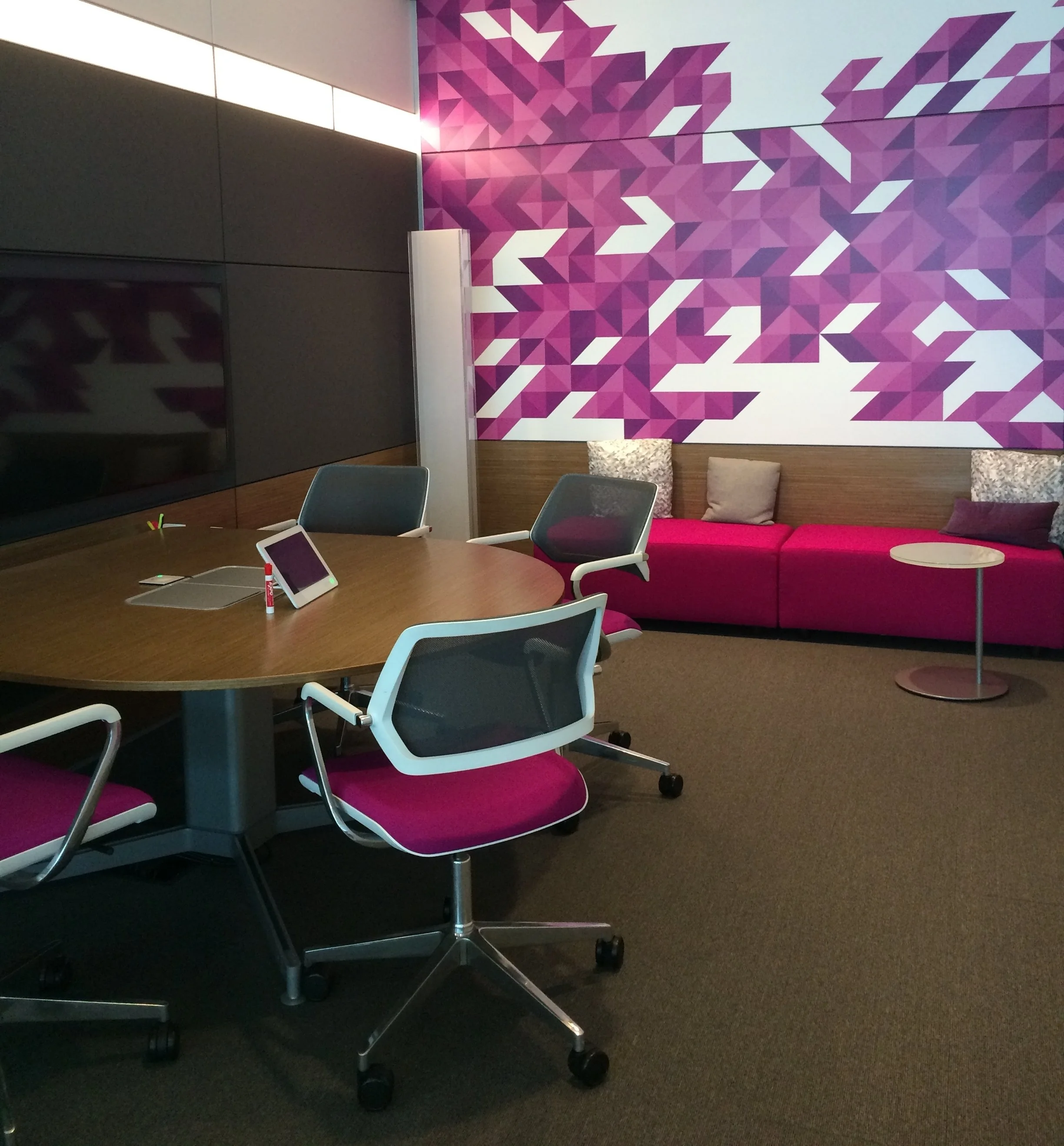
For an ultra-sleek look, Steelcase's office in Grand Rapids, MI vibrates with a mix of ultraviolet and neutrals. Mixing many colors can get too intense too quickly, so using a bold violet with white is a fresh but straightforward way to modernize an office.

Last but not least, this beautiful space sits right next to the ocean. Many people's first instinct is to add blue to a beach home to echo the sea. However the area is quite literally surrounded by blue, so adding more can quickly get tired and dull. Instead, analogous colors–bright green and purple–were used to add life to the room and complement the ocean outside.
Pantone's annual announcement is an opportunity to be creative and update your home or office. Ultraviolet is daring and sophisticated. If you are interested in adding an air of curiosity, wisdom, and richness to your home, give it a pop of Ultraviolet!
Sarah Barnard designs healthy, happy, personalized spaces that are deeply connected to nature and art.
To learn more about Sarah Barnard Design, please visit www.SarahBarnard.com.
Photos by Chas Metivier, Steven Dewall.

Designing a Safe Space for an Autistic Child

Designing a calm environment for children with autism can seem like a daunting task. While every child is different and may react differently to specific situations, there are five key home design points to consider to successfully achieve a calm and structured space.
Layout
Consider the scale of the space. What do you want to integrate into the room? One way to successfully choose what you want to include in the place is knowing your child’s needs, and paying close attention to how your child responds to an environment. How do you want your child to navigate through the space? Start the layout by placing the furniture on the sides of the room and leaving the middle open to navigate. This layout is not only simple but easy for the child to move around the room. When placing the furniture on the sides, the child can easily access things he/she needs within the room, fostering independence.
Often children with autism are more comfortable in rooms with clear divisions. Consider subdividing rooms and allowing for reconfiguration. Plan secure storage for items so they can be cleared away quickly when not in use.

Noise
Noise is another aspect of designing a room that is often forgotten about but is essential when creating a space for a person with autism. Children with autism are sensitive to loud noises and sometimes cannot filter them out. This sensitivity may cause anxiety, affecting the way the child behaves daily. There are simple ways to prevent background noise from filtering in. Start by pinpointing what background noises you can easily hear from the room that may cause discomfort to your child.
Keep the background noise out by integrating small fixes. Try applying acoustic panels to your walls; this not only brings down the sound, but it can serve as a discrete and functional decorative element.
If the first option is not something that would be convenient, another way to bring the noise down would be to replace any hardwood flooring with carpet. Not only is this recommended for children with autism because it reduces the chance of your child getting hurt and prevents lighting glare, but it also prevents noise from echoing throughout the room.
If damping the noise is not possible, try adding pink noise. Similar to white noise, pink noise may improve memory and be better at gently drowning out disturbances.

Lighting
Lighting can have a substantial effect on someone’s mood. Just as we can be affected by specific light, children with autism are often hypersensitive, therefore specific lighting should be considered when integrating fixtures. One thing to stay away from is fluorescent lighting. Fluorescent lighting is known to flicker and depending on the wattage and lamp type can be extremely bright. The flickering is not only distracting, but it is known to cause eye strain, headaches, and migraines. Opt for a fixture with diffused lighting or an installation with adjustable settings in a neutral, unsaturated color. Being able to dim the light can make a difference for someone’s mood.
Color
Choosing the right color for the room is an essential step. Choose light, neutral colors. Just as bright lights can affect the mood of the child in a negative way, specific colors can have similar effects. Colors to stay away from are anything bold or dark. Although primary colors tend to be the norm when choosing room colors for children, it is not the case when choosing a room color for a child with autism. Bold colors are allowed in small accents, such as their toys.
Also, wallpapers with busy patterns or stripes can be distracting for your child. Be especially careful to choose a paint that is non-toxic and does not off-gas, to keep your child safe. Try pale blues, soft greens, light purples, and pale pinks for room color options.

Privacy
Research has shown the benefits of a sensory room (or space) for kids with autism. These spaces allow children to feel safe. You can integrate certain things into a sensory room for the child to feel better. As stated previously, layouts are essential. If it is not possible to dedicate an entire room, a corner of a room can be reserved specifically to be the "sensory room," by separating the space with a dark curtain. The idea is to make a place the child can feel comfortable and stress-free. Items such as a bean bag, or a sensory pea pod sold online can help a child feel comfortable and safe.
With these simple ideas in mind, your home can be a safe place for both you and your autistic loved one.

Photos by Chas Metivier, Steven Dewall
Sarah Barnard designs healthy, happy, personalized spaces that are deeply connected to nature and art.
To learn more about Sarah Barnard Design, please visit www.SarahBarnard.com.

Award Winning Los Angeles Interior Designer Achieves WELL Accreditation
Interior designer and Leadership in Energy and Environmental Design Accredited Professional (LEED AP), Sarah Barnard of Sarah Barnard Design has recently achieved recognition from the International WELL Building Institute (IWBI) as a WELL® Accredited Professional. The WELL Building Standard® is the premier standard for buildings, interior spaces and communities seeking to implement, validate and measure features that support and advance human health and wellness.


WELL was developed by integrating scientific and medical research on environmental health, behavioral factors, health outcomes and demographic risk factors that affect health with leading practices in building design and management. WELL Certification and the WELL AP credentialing program are third-party administered through IWBI’s collaboration with Green Business Certification Inc. (GBCI), which also administers LEED certification, the global green building program, and the LEED professional credentialing program. This relationship assures that WELL works seamlessly with LEED.

Sarah Barnard Design was established in 2003 with a focus on creating spaces that are respectful of history, healthy, art-forward, and deeply connected to nature. Sarah was LEED accredited in 2007 and WELL accredited in 2017. Some of her notable projects include the National Immigration Law Center, Heritage Square Museum, National Geographic Entertainment, and numerous beautiful residences.

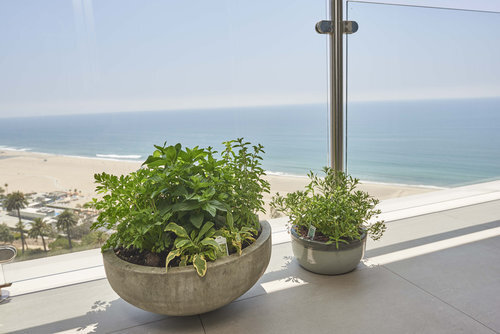
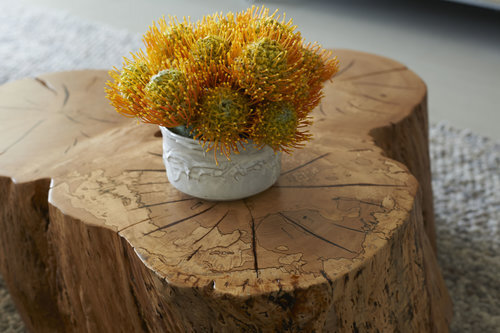

Barnard was recently recognized as an American Society of Interior Designers (ASID) National Ones to Watch Scholar, was featured in the July 2017 Issue of Metropolis Magazine and is scheduled to guest lecture at the 2018 ASID National Student Summit, SCALE in Los Angeles, CA.
Sarah Barnard designs healthy, happy, personalized spaces that are deeply connected to nature and art.
To learn more about Sarah Barnard Design, please visit www.SarahBarnard.com.
For more information about WELL https://www.wellcertified.com/en

Remodeling Your Kitchen to Last Forever

As many people move towards preparing their meals, and as open-plan homes embrace nature and health, the modern kitchen is more important than ever. A kitchen must provide high-quality performance and functionality to cater to your specific needs and to add to the value of your home. Many homeowners know a remodeled kitchen would benefit their lifestyle, but do not want to commit to the expense and disruption of a remodel. The best way to approach a kitchen-remodeling project is to create a plan that focuses on your family’s specific needs to balance form and function and make your kitchen the ideal space for cooking and entertaining while being comfortable for everyone.
It is best to start by establishing what areas in the kitchen are most frequently in use. Take into consideration how many people might use it at once, and if there are children involved, make sure your kitchen accommodates their safety. Typically it is best to have the main functions of the kitchen–your stove, sink, and fridge–no more than six feet apart from each other. This calculation will help create a working triangle that benefits you by allowing easy maneuvering throughout the space. Identify areas that need extra storage for food, snacks, or dishes for display. Some particular functions require more space than others.

It is also essential to make your kitchen a space that you cannot only use, but enjoy. Make a list of what is important to you, and consult a designer if you can. She or he will help you decide what is realistic, possible and practical for your home, and determine what areas are the areas as focal points in the room. If you love to have people around while you are cooking, add seating at the counter. If many people use the kitchen together, consider implementing various food preparation areas. By considering using universal design methods, such as lower countertops, two-tiered kitchen islands, and under counter storage for food and appliances, homeowners and guests can access all areas of the kitchen with ease.
Often overlooked, lighting is hugely important to a kitchen. Determine what lighting options are best suitable for different kitchen zones. Interior designers can be especially useful in this area and will help define what lighting would be best for tasks and overall aesthetic value for the different spaces in your kitchen. Under cabinet lighting is a great technique to display a favorite kitchen item or to find kitchen products quickly. Recessed lighting and pendant lights can help create an even ambient light throughout the space.

Finally, when redesigning a kitchen, there should be a focus on making it a beautiful and pleasing place to be, as well as providing functionality. If the kitchen connects to the dining room or living areas, consider how it can relate visually to people entering the space. There should be a visual connection from the kitchen between its connecting rooms. If the kitchen has barriers from other areas, consider opening up those spaces so the rooms can connect visually and practically. Finally, consider storing appliances to look like they belong in the kitchen without standing out. To accomplish this, use panel-ready appliances or incorporating under counter microwaves or oven drawers to create extra counter space in a kitchen island.
A remodeled kitchen should work with the needs of the homeowners in a way that creates a space that can be used by everyone. Also, a kitchen should support the needs of your entire family’s lifestyle and still be a place of beauty and comfort. By implementing smart technology and planning, a kitchen can save time and energy. By focusing on functionality and durability, your kitchen can be a space that can be enjoyed by everyone for years to come.

Sarah Barnard is a member of the American Society of Interior Designers (ASID), is certified by the National Kitchen and Bath Association (NKBA), and is recognized by the International WELL Building Institute as a WELL Accredited Professional (WELL AP), the International Institute for Bau-Biologie & Ecology as a Building Biology Practitioner (BBP) and by the United States Green Building Council as a Leadership in Energy and Environmental Design Accredited Professional (LEED AP). She has served on the Santa Monica Conservancy's board of directors and specializes in sustainable interior design, health and wellness and historic preservation.
Undertaking a broad range of projects, all of which are grounded in smart design and mindful of healthy living, Sarah’s diverse body of work includes upscale private residences, chic restaurants, luxurious spas and impressive corporate headquarters. Her projects have been featured in local and national publications, and have placed prominently in several noted design competitions. Sarah holds a Master of Fine Arts degree from Claremont Graduate University as well as undergraduate degrees in Art and Interior Architectural Design. Her interior design practice is the culmination of education and interests in art, architecture, textiles and the environment and she has written several articles for important publications including the USGBC, United States Green Building Council.
Sarah Barnard, WELL AP and LEED AP, designs healthy, happy, personalized spaces that connect deeply to nature and art. Empathy and mindfulness are the foundation of her practice creating healing, supportive environments that enhance life.
Photos by Chas Metivier, Scott Van Dyke, Brad Nichol
Sarah Barnard designs healthy, happy, personalized spaces that are deeply connected to nature and art.
To learn more about Sarah Barnard Design, please visit www.SarahBarnard.com.

3 Simple Steps to Create a Bathroom That Will Stand the Test of Time

Although bathrooms can be small spaces, they are substantial investments in your home. Restrooms should provide not only functionality but beauty and comfort for both homeowners and guests. An ideal bathroom design incorporates functionality, support, and beauty, regardless of age or mobility.
1. Planning Ahead
Prioritize the space: When remodeling a bathroom, remember to establish what areas are best suitable for specific tasks. Plumbing, outlets, and ventilation are all critical elements to a high-functioning bathroom. Consider adding outlets for hairstyling products, or adding ventilation close to the shower. However large or small your bathroom may be, it is essential to address which areas used most, how, and by whom.
Smart storage: Bathroom designers should consider the specific needs and storage requirements of you and your guests to ensure the bathroom to feel spacious and organized. For example, the area next to where you apply makeup or shave may need hidden drawers or a built-in cabinet. Children’s bathrooms may require space for bath toys or step stools.
2. Safety and Comfort for Everyone
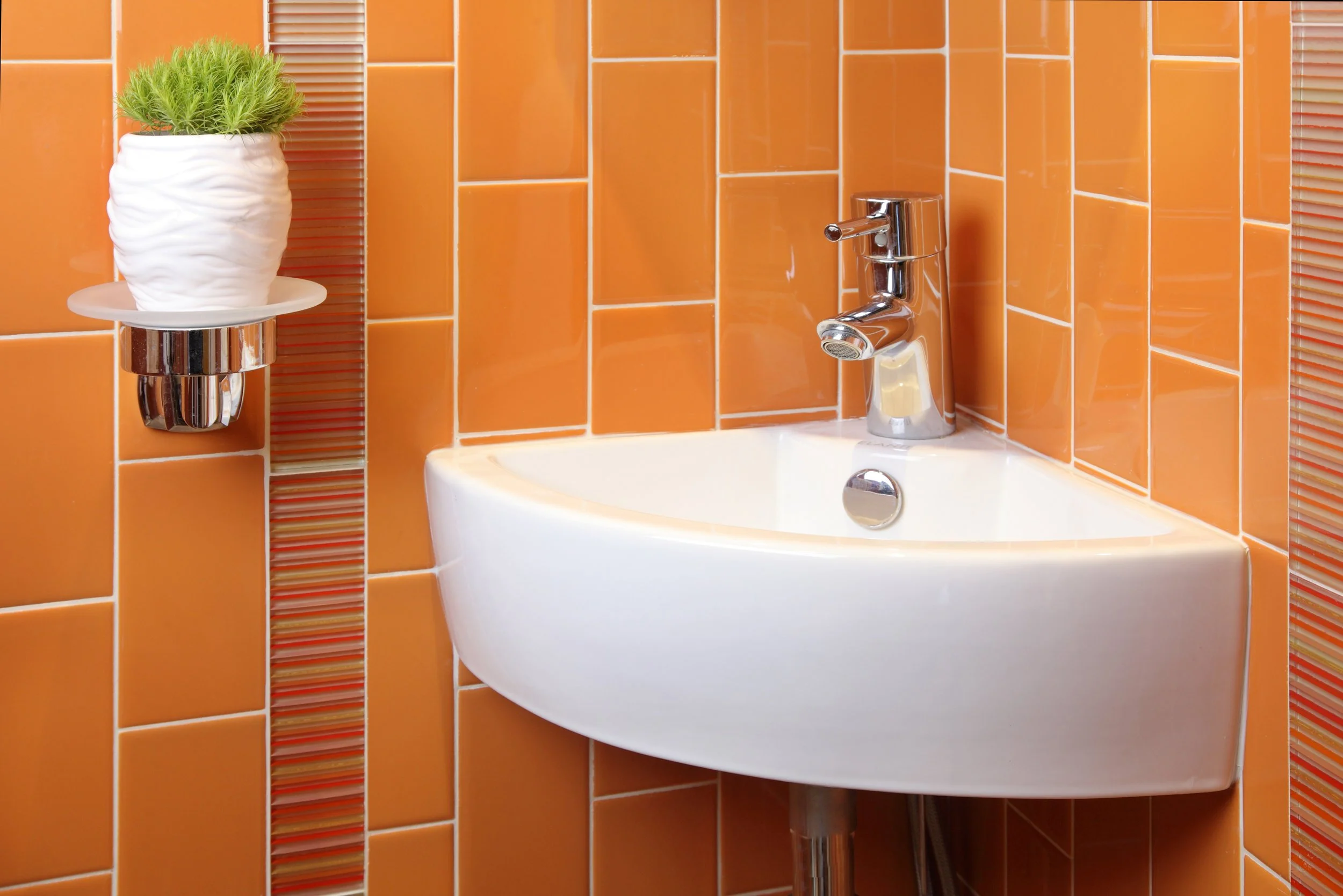
Use readily available strategies: Barrier-free showers, slip-resistant flooring, and lever-style door handles are safe and straightforward. Planning to make bathrooms comfortable and accessible may also help save money in the long-run. You can have comfort by knowing that these implementations will last, and there is no need to remodel again.
Consult an expert: Home design professionals can help implement universal design methods into any bathroom space. They can plan for accessibility, the environmentally conscious, and help you achieve a classic style that will not need to be replaced again in a few years.

3. Luxurious Experience and Materials
Use a variety of lighting: Lighting is a crucial component of good bathroom design and can help improve the human experience. Task lighting should be in places used for applying make-up or in other preparation areas. Ambient light can create a soft look, and pleasant feel to the room.
Choose the right materials: When choosing colors and articles for the bathroom, select options that are durable and easy to clean to save yourself time and headache later on. Also, consider timeless materials and avoiding fads so that the bathroom’s beauty can endure.
It may seem like a daunting task, but your bathroom can be a serene and healthy space with careful planning, consideration for safety and accessibility, and the right materials. Start with a clear vision and be mindful of health, sustainability, and timeless style to make the most out of your bathroom.

Photos by Chas Metivier
Sarah Barnard designs healthy, happy, personalized spaces that are deeply connected to nature and art.
To learn more about Sarah Barnard Design, please visit www.SarahBarnard.com.

Designer Crush: Sarah Barnard

Designer Crush: Sarah Barnard
Upscale private residences, chic restaurants, luxurious spas, and corporate headquarters: all are fair game to Los Angeles designer Sarah Barnard. With specialties in sustainable interior design, health and wellness, and historic preservation, Barnard brings a passion and dedication to her projects uniquely grounded in innovation. Barnard is currently involved in interior design projects in the Pacific Palisades, Santa Monica, Brentwood, Los Feliz, Hancock Park & Palos Verdes Estates. Learn more about the designer in our Q&A below.

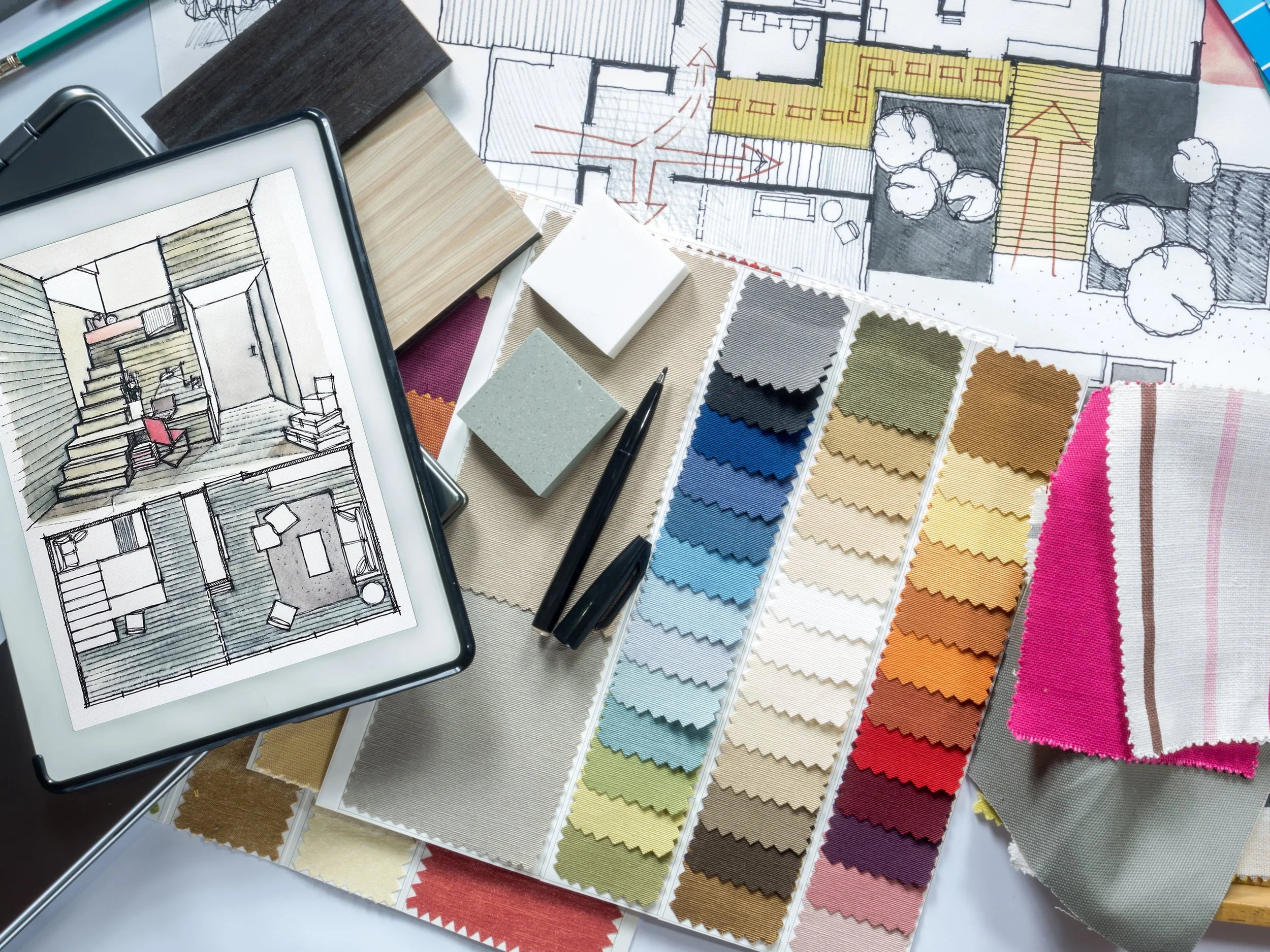


In this interview with CA Homes and Design, Sarah Barnard opens up about how she found inspiration growing up in historic homes. Art, interior design, and sustainability have been a central part of her education and experience. In graduate school, Sarah explored sculpture and environmental installations. As a native Angelino and artist, she quickly carved out a niche for herself in sustainable, healthy design.
Health and wellness are central pillars of Sarah’s practice. She explains how a connection to nature and the outdoors can improve the quality of a person’s life and make a home more beautiful and comfortable. She gives careful consideration to each project to produce a home that contributes to the wellness of the homeowners.

When beginning a new project, Sarah visits the space and observes her client’s current situation. She learns about what they like, what they don’t like, and what they want out of the transformation to make the process as seamless and effective as possible.
Sarah explains that ’California’s style embodies the values of the people here and reflects the landscape’s mountains, deserts, sea, and sky.


Sarah continues to draw inspiration from nature and cultivates a diverse garden of fruits, vegetables, flowers, and succulents. Some of her favorites are Abutilon, Brugmansia, and Camellia.
Sarah believes that travel broadens the mind. Her travels through Milan, Paris, and Victoria were centered on nature, food, architecture, and art.

Asked about her favorite musical artists, Sarah chose strong, independent women like Ingrid Michaelson, Sarah Harmer, and Corinne Bailey Rae. Her favorite movie, The Other Boleyn Girl, stars two of her favorite actresses: Scarlett Johansson and Natalie Portman.

Please be sure to check out this interview on CA Home and Design’s website for Sarah’s full answers.
By Michelle Konstantinovsky
Sarah Barnard designs healthy, happy, personalized spaces that are deeply connected to nature and art.
To learn more about Sarah Barnard Design, please visit www.SarahBarnard.com.

Vegan Interior Design
“You can still have everything you want, even if you are vegan,” Sarah Barnard explained. For those vegans who want to surround themselves with luxurious vegan linens, more natural, beautiful and durable vegan materials are available than ever. If you are the type of vegan who loves the look of animal products, more and more perfect options are available for you as well. Los Angeles home designer and recent ASID award-winner Sarah Barnard took time to go over the growing vegan interior design market and her experience with clients who care about animals. “Happily, the days of sacrificing comfort for principles are over. There are plenty of luxury options for vegans, too.”
Of course, vegan and vegetarian mean different things to different people. It helps to clarify your preferences ahead of time. A knowledgeable designer can help you sort through what is desirable to bring into your home and what isn’t, and can help with any additional design considerations that frequently go hand-in-hand with a love of animals, like the desire for an eco-friendly home. DIY strategies are abundant on sites like Pinterest or Etsy, but some subtle animal materials may slip past you if you aren’t sure what to avoid, or less perfect materials may get selected by default.

“If vegan living is important to you, find an interior designer to help you. It’s the best way to make sure you feel good about your design decisions,” Barnard explained. “Ideally, you would work with a designer who has experience and vegan resources prepared.” One must vet each component of every item. There are the obvious things: fabrics, leather, and fur. But plenty of materials that you wouldn’t expect to use animal byproducts, too. Paint, glue, and lacquer are less obvious and slip by unnoticed most of the time. Old master painting or collectible paintings, for example, can potentially have small amounts of animal byproducts: nevermind that canvas was sometimes made of animal hide, but eggs were used to make tempera paint, and some pigments were derived from animal skin or hair as well. “Essentially, every part of every item could potentially bring animal products into your home.” Barnard cautioned. When asked how she avoids this, she answered, “I work closely with local artists and manufacturers that work with vegan materials. The artists care deeply about animals and the environment and make careful choices in the selection of materials.”
Some things that may be marketed as a cruelty-free product need to be verified also. For example, some silk manufacturers claim they wait until the silkworms have died to harvest their cocoons, but less reputable manufacturers have been caught lying about their processes.
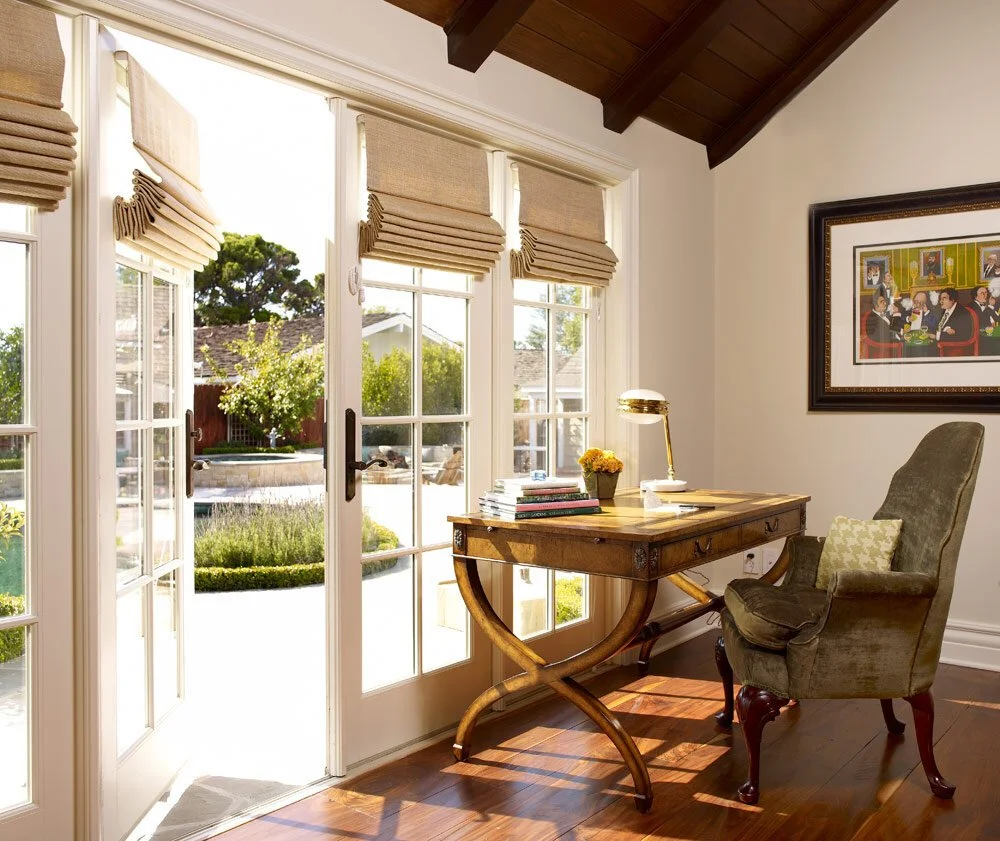
While it can be exhausting searching for an alternative, don’t settle for just any synthetic material. A designer has access to samples and access to a myriad of information on the manufacturers’ technical specifications on art, furniture, and building materials.
Consider your health when designing or decorating your home with synthetic materials. Humanmade options could mean introducing elements that off-gas chemicals into your home. Vinyl and PVC for example, have been known to release chemicals for at least two weeks after installation. There are plenty of safe synthetic materials made by responsible manufacturers.
If you were on the fence about making your home vegan, consider that for a family member or guest with allergies, making your home vegan can be an excellent way to make sure there are no allergens that cause discomfort. Artificial down, for example, can be better than it’s feathery counterpart because alternatives are often water-resistant in addition to being hypoallergenic.

For a family member on the autistic spectrum, the smell of animal leathers and the rough textures of some wools and skins may be bothersome. Ideally, a space designed for them has carefully considered and created the materials, lighting, and flow.
When asked about her favorite part of designing a vegan home, Barnard said, “Vegan interiors often end up being automatically eco-friendly.” It turns out vegan homes can have a smaller carbon footprint, simply because any process involving cultivating materials from animals means using resources to care for the animal to grow, and the carbon dioxide they exhale during their cultivation contributes to a large carbon footprint. Wood should be researched as well and sourced from responsible, sustainable sources, or reclaimed from previous projects and buildings.
Whatever your reason for choosing a vegan home, it should be relevant to the designer who helps you create your perfect home, too. You don’t have to sacrifice style or comfort; more than ever, it is possible to luxurious, durable, cruelty-free, materials.

Sarah Barnard designs healthy, happy, personalized spaces that are deeply connected to nature and art.
To learn more about Sarah Barnard Design, please visit www.SarahBarnard.com.
Photos by Chas Metivier and Steven Dewall.

Designing a Compassionate Community: How Designers Can Create Mutually Beneficial Relationships with Non-Profits

Sarah Barnard will be presenting at SCALE the American Society of Interior Designers (ASID) National Student Summit in Los Angeles on February 23-25. Hailed as “the must-attend event of the year for interior design students” SCALE is an excellent resource for both students and educators who care about the impact of design on human life. Students of interior design will gain exclusive insights into a variety of professional roles, and educators will explore current topics and resources to expand their programs. Students studying other built environment professions such as architecture, landscape architecture, and urban planning will also benefit from the multi-disciplinary speakers and diversity of topics presented at SCALE.

As a recent ASID Scholar award winner, Sarah Barnard LEED A.P. has been selected amongst a highly curated roster of speakers to discuss her interior design practice and methodology for creating mutually beneficial relationships with non-profit organizations. “The potential for sustainability and growth is the product of symbiotic systems,” says Sarah Barnard. “Designing a compassionate community is about building relationships that are long-lasting.”


Sarah has been committed to helping organizations that protect and advance our society as well as our humanity, standing firm in a quest to aid institutions such as The Heritage Square Museum, the Santa Monica Conservancy and the Olmstead Preservation Association which work to protect architectural and cultural histories. Additionally, she has served the Downtown Women's Center which provides permanent supportive housing to homeless women; the National Immigration Law Center which protects immigrants, low-income workers and people of all genders and sexual orientations; Life Rolls On/ Christopher and Dana Reeve Foundation which aids and inspires people with disabilities.
Sarah says, "These types of organizations have never been more important to our well-being, yet in present times, are at great risk. I understand that by providing pro-bono design services, securing donations of goods and services and by always continuing to encourage growth and expansion of a compassionate community, we can encourage each other to create a better world, with hope, beauty, and dignity."
SCALE The ASID National Student Summit with be held at the Sheraton Grand located downtown at 711 S. Hope St. Los Angeles, CA 90017.
Sarah Barnard designs healthy, happy, personalized spaces that are deeply connected to nature and art.
To learn more about Sarah Barnard Design, please visit www.SarahBarnard.com.

Interior Design for Pets

PHOTO BY: STEVEN DEWALL
"It's important to start with the needs of the entire family," says Los-Angeles-based interior designer and recent ASID award-winner, Sarah Barnard. "Your pets should be included in the home design process from day one, because they are family members, too." Barnard is currently a mother to two furry friends, a rescue cat with half a tail and a dog that isn't happy unless she's sitting in your lap. She explained her process when she works with clients who have both standard and exotic pets.
"When I start designing a home, my goal is to make an environment that is natural, enduring, and high-functioning—for my clients, their guests, and their pets." The goal is a design that is mutually perfect for pets and humans alike. When it is planned this way from the beginning, it is more comfortable for everyone, including you.
The interactive design doesn't mean the same thing for everyone; every family has different needs. Consulting a designer can help you figure out how much extra planning is required and where to get started. Consider that where you spend your time, so does your pet. They want to be near you, so a dedicated dog room, for example, may be a lost cause.

Next, consider your lifestyle. If you take your dog hiking, having space for to rinse and towel off before venturing further inside your house is a smart choice. Most animals, mainly if they live exclusively indoors, enjoy a perch next to a window. Aquariums or terrariums can be entertaining for them as well. If you spend a lot of time in the kitchen, a custom pet bed or feeding area might be a great fit in your kitchen island.
More exotic pets might require more customization. Large animals like pigs may need an indoor and outdoor space. Reptiles or birds sometimes need a large aquarium or terrarium designed into the architecture of your home. That's when it's necessary to have a designer's help. She or he will plan it out and make sure you seamlessly integrate your pet's home with yours. More importantly, a designer can help you figure out the scope of your project.
When asked about materials, Barnard said the goal is "to create high-functioning, natural and non-toxic environments that endure over time." It's best to make your home safe for everyone. Try to source organic materials as much as possible, such as untreated fabrics and furniture. Vintage pieces that are at least 20 years old have finished off-gassing, so they don't pollute the air and are safer for you and your pets.

As far as specific materials and finishes, nothing is strictly off-limits, but some require more upkeep or need to be replaced every few years. Barnard shared some insights on balancing which materials are most attractive with those that create less work for you:
It's still possible to have wallpaper, but a more durable option would be wood wainscoting.
For flooring, the best choice is often a hard surface option whenever possible. It's easier to keep clean than rugs or carpet and doesn't hold onto fur or odors. Porcelain tiles are a great option. They are elegant and easy to maintain, plus they aren't likely to stain or get scratched. Porcelain tiles are also the same color all the way through, so dents and marks will be less noticeable.
Carefully consider your fabric choices, too. Solution-dyed acrylic textiles are an excellent place to start looking because they are relatively invulnerable. They're typically resistant to stains, germs, and odors.

Some fabrics are more durable than others, but how they are used matters, too. Any materials with uneven surfaces will be more challenging to clean. Delicate fabrics are best saved for window treatments rather than upholstery. Choose shorter drapes that won't be chewed or rubbed against; long curtains may collect hair or inadvertently become a hazard. Remove fabric from reach by choosing chairs and sofas with exposed legs, which won't hold onto furs like slipcovers or upholstered legs.
"Above all, make sure you find a designer who has a history with animals. One who has an animal family member is even better," Barnard suggested. Designers who live with pets will have a more intuitive way of designing a home that includes them. They know more about how pets act and behave then designers without them.
Barnard shared a favorite experience working with a client with pets. "She had close to 12 cats, and wanted a dedicated area where her cats could sun themselves, but was concerned about coyotes in the area. We decided to build a custom screened porch to make a safe space for them. We had cat doors installed, too, so they could come and go as they pleased."
Sometimes making an appropriate environment for a large group of animals is the solution, sometimes the answer is cat-ifying or dog-ifying the whole house. Every home is different, but with the right help, you don't have to sacrifice beauty to live with your beloved pets. When all is said and done, our animal friends are worth a little extra planning.
Sarah Barnard designs healthy, happy, personalized spaces that are deeply connected to nature and art.
To learn more about Sarah Barnard Design, please visit www.SarahBarnard.com.
Photos by Steven Dewall, Chas Metivier, and Brad Nicol

How To Stay in Your Home Forever
For many, a home is a place of comfort. It acts as a sanctuary, where people can escape the busyness and hectic atmosphere of life. The benefits of making a home a place of comfort, luxury, and accessibility will not only be beneficial for immediate satisfaction but will also allow people to stay in their homes for as long as possible. By utilizing the resources that are available such as hi-tech designs, strategies that benefit everyone in your home, and spaces that focus on the emotional value, homeowners can enjoy being in the comfort of their own home for many years and will benefit from its results in their daily lives.

Homes designed for everyday ease-of-use can benefit everyone from toddlers through grandparents. By utilizing available technology, everyone will be more comfortable in his or her living environments. One current emerging design in the industry that has benefitted its users is the addition of motion sensor lighting to rooms. Not only are these developments benefitting people practically, but it also helps the environment by saving electricity. Another developing design that benefits its users is smart appliances. Appliances that offer sensor operating systems also can positively impact day-to-day living by making food preparation and kitchen storage simple and easy to use.

Home redesign can seem like a daunting process; however, the results will ultimately make a home more luxurious, safe, and accessible to its users. Living in a comfortable environment should not decrease the aesthetic value of a home. Interior designers can be used as helpful tools in this area to create and organize a unified living environment that meets all the needs of its users, while still being a beautiful space. By integrating designs with features such as walk-in showers, sensor faucets, under-counter appliances, and larger pantries, homeowners will see the immediate results that can improve their day-to-day living. Spaces that are open and barrier-free can create an inviting and spacious feel to the bedroom and living room areas while being safe and functional spaces for everyone. This consideration not only can improve the lives of many but also help homeowners through every stage of life from having young children and the elderly in their homes. These small changes will enhance the quality of living that everyone deserves.

PHOTO BY: STEVEN DEWALL
A sanctuary can come in many forms, but people should be able to call their own home a safe place of comfort especially. Everyone should experience a living environment that is comfortable, easily accessible, and a beautiful place to be. There are benefits of integrating designs and technology that will benefit a homeowner’s life currently, and for many years after. The rewards experienced when investing in making a home the best possible place to live are priceless. It is vital that people have a connection to their living environment, and it all starts with making that first step. Simple upgrades that are available now will have long-term benefits that will impact everyday living. Making improvements will create a better overall living environment, and will cause homeowners to be satisfied with their home now and in the future.
Sarah Barnard designs healthy, happy, personalized spaces that are deeply connected to nature and art.
To learn more about Sarah Barnard Design, please visit www.SarahBarnard.com.

Sarah Barnard: LEED AP, Interior Designer, ASID Scholar Award Winner

Sarah Barnard has been recognised by the American Society of Interior Designers (ASID) as a rising leader in the interior design industry demonstrating exceptional leadership and a willingness to push the boundaries of the profession. Awarded with the highest honor of Scholar, the ASID recognises Sarah's commitment to fostering connectivity and growth throughout the community.


"As a LEED AP, I design healthy, sustainable interiors for non-profit organizations that work to protect our architectural and cultural heritage and fight for social and environmental justice."
Sarah has been committed to helping organizations that protect and advance our society as well as our humanity, standing firm in a quest to aid institutions such as: The Heritage Square Museum, the Santa Monica Conservancy and the Olmstead Preservation Association, working to protect architectural and cultural histories; the Downtown Women’s Center providing permanent supportive housing to homeless women; the National Immigration Law Center providing protection for immigrants, low-income workers and people of all genders and sexual orientations; Life Rolls On-Christopher and Dana Reeve Foundation, aiding and inspiring people with disabilities.
"These types of organizations have never been more important to our well-being, yet in present times, are at great risk. I understand that by providing pro-bono design services, securing donations of goods and services and by always continuing to encourage growth and expansion of a compassionate community, we can encourage each other to create a better world, with hope, beauty and dignity."

Sarah Barnard is a member of the American Society of Interior Designers (ASID), is certified by the National Kitchen and Bath Association (NKBA), and is recognized by the International Institute for Bau-Biologie & Ecology as a Building Biology Practitioner (BBP) and by the United States Green Building Council as a Leadership in Energy and Environmental Design Accredited Professional (LEED AP). She has served on the Santa Monica Conservancy's board of directors and specializes in sustainable interior design and historic preservation.
Undertaking a broad range of projects, all of which are grounded in smart design and mindful of healthy living, Sarah’s diverse body of work includes upscale private residences, chic restaurants, luxurious spas and impressive corporate headquarters. Her projects have been featured in local and national publications, and have placed prominently in several noted design competitions. Sarah holds a Master of Fine Arts degree from Claremont Graduate University as well as undergraduate degrees in Art and Interior Architectural Design. Her interior design practice is the culmination of education and interests in art, architecture, textiles and the environment and she has written several articles for important publications including the USGBC, United States Green Building Council.
Sarah Barnard, WELL AP and LEED AP, designs healthy, happy, personalized spaces that connect deeply to nature and art. Empathy and mindfulness are the foundation of her practice creating healing, supportive environments that enhance life.

Contemporary Luxe: Children's Rooms

A pair of contemporary luxe children's rooms fit for a beachside family home. A boy's bedroom is transformed into a 'little man's' room with the warmth of traditional design elements and cutting edge details to create a youthful, contemporary space.
With a focus on personality and creativity, Sarah Barnard incorporated custom artwork based on conversations she had with each child. The boy's bedroom features a mural of a vintage Aston Martin inspired by the classic James Bond film 'Goldfinger.'

A little girl's bedroom is full of warmth and whimsy. The smocked pink drapery and antique painted beds are a traditional foundation while the light fixture, custom polka-dot chairs, and bubble murals create a playful harmony.

Above each girl's bed, a custom mural made from recycled art glass features imagery inspired by their favorite things. The hand-painted lettering adds a unique element of personalization distinguishing each girl's space.

Sarah Barnard designs healthy, happy, personalized spaces that are deeply connected to nature and art.
To learn more about Sarah Barnard Design, please visit www.SarahBarnard.com.
Photos by Charlie Daniels

Contemporary Luxe: Indoor Outdoor Family Room
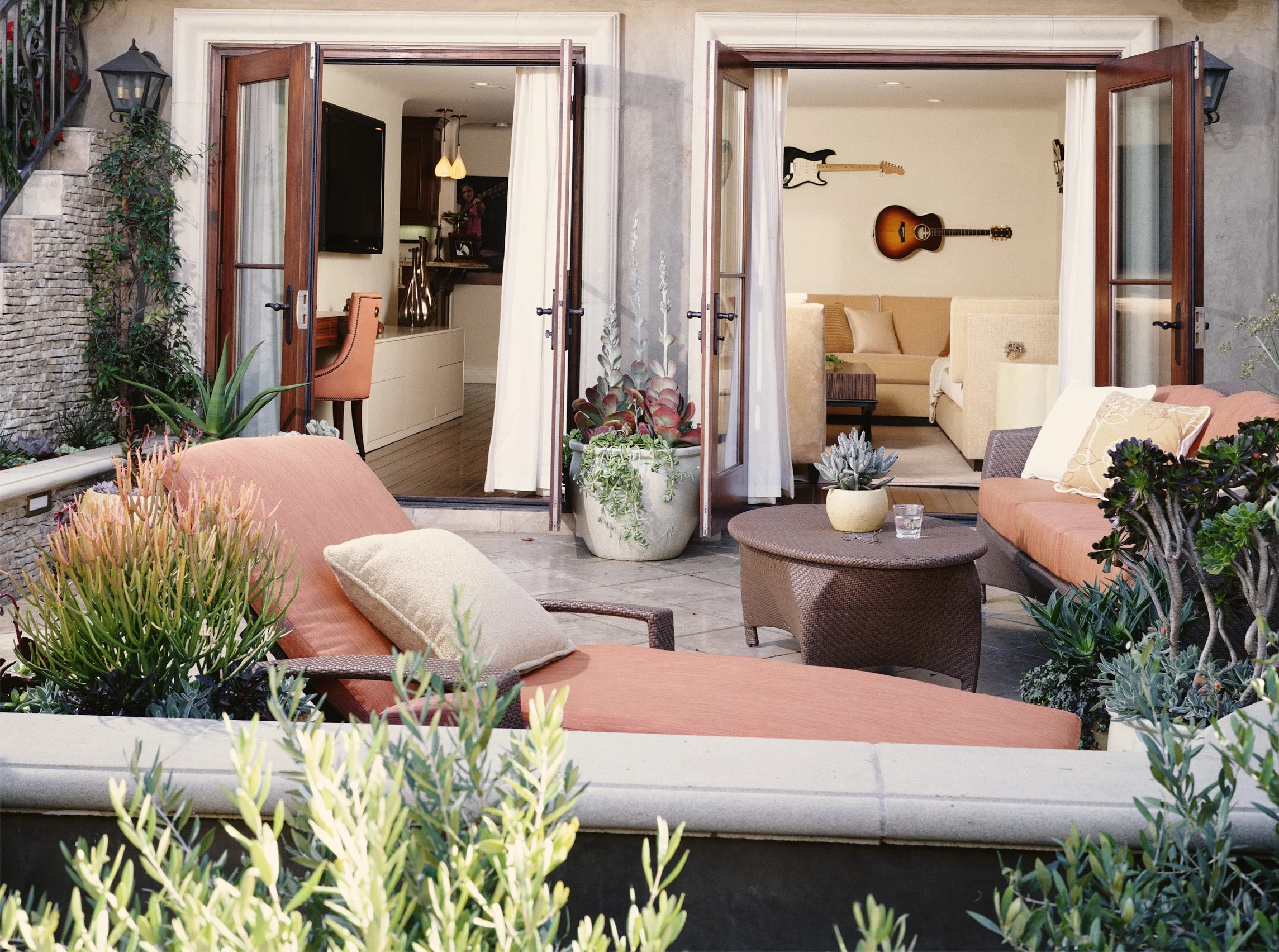
This contemporary luxe family home has a cozy patio pairing luxurious outdoor textiles with Chinese artisan pottery to create a quiet retreat. The modern luxury of this patio level family room reflects the individuality and youth of the homeowners.

With a focus on the homeowner's art collection, Sarah Barnard's home design allows for plenty of display space featuring one of a kind pieces: an antique brass lamp, a vintage Japanese sculpture by Kent Artware and a hand carved mahogany conch shell from Negril.

An innovative guest room features a custom bed with a metallic leather headboard and a claw foot base. Luxurious silk bedding and warming brass accents adorn this contemporary retro bedroom.

A second guest bedroom hosts twin beds with matching leather bolsters. The painstakingly veneered custom headboard features a floating desk drawer and a vintage 1930's office chair that melds Hollywood Glamour with Industrial Chic.

Sarah Barnard designs healthy, happy, personalized spaces that are deeply connected to nature and art.
To learn more about Sarah Barnard Design, please visit www.SarahBarnard.com.
Photos by Charlie Daniels

Historic Craftsman Bungalow: Dining Room

A historic 1918 Craftsman Bungalow features a beautifully remodeled dining room with contemporary updates by Sarah Barnard Design. By utilizing and restoring pieces original to the property, Sarah preserves the home's traditional aesthetic while introducing modern elements to create something personalized and unique. The fresh blue wall color modernizes the otherwise traditional dining room complementing the deep redwoods of the vintage furniture.
An original built-in cabinet, a collection of art objects, a vintage dining table, and a contemporary chandelier sing together in harmony. A ceramic bust by artist Deborah Cansler rests atop an original antique cabinet with plenty of display space for the homeowner's eclectic treasures. An arrangement of wild blue thistles in a ceramic vessel made by artist Nashua Alfaro creates the perfect centerpiece.


Sarah Barnard designs healthy, happy, personalized spaces that are deeply connected to nature and art.
To learn more about Sarah Barnard Design, please visit www.SarahBarnard.com.
Photos by Chas Metivier
Historic Craftsman Bungalow: Living Room

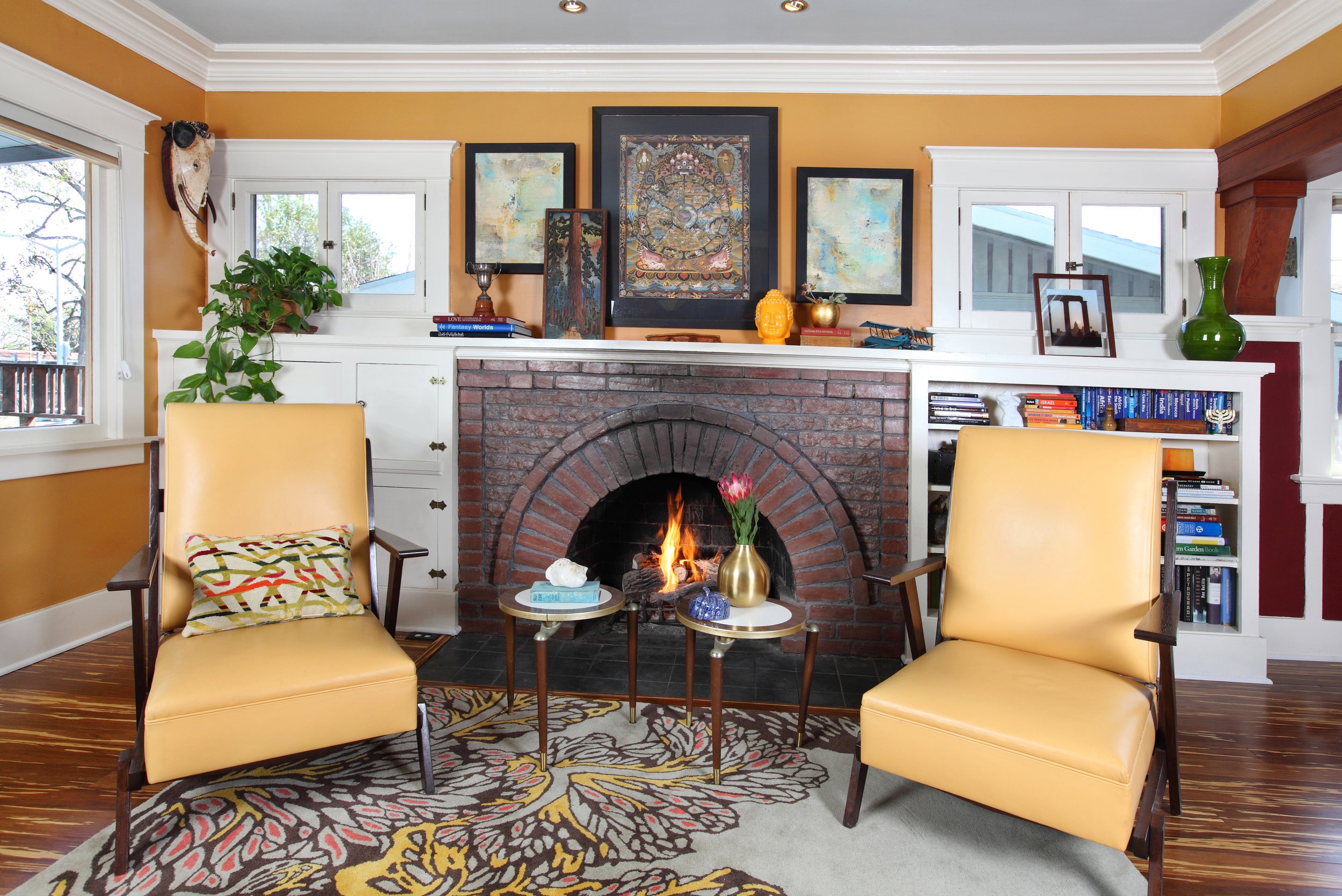
A historic 1918 Craftsman Bungalow gets a fresh face! Utilizing the original Arts & Crafts woodwork design, Sarah Barnard adds a pop of contemporary color for an updated take on this traditional style. In keeping with the classic aesthetic, Sarah treats the interior with eclectic and vintage mid-century modern furnishings.
Saturated colors and modern patterns pair perfectly with wood and brass accents. At the heart of the living room is an original brick fireplace restored to its former glory. Items collected on the homeowner’s travels make fast friends on the mantle with abstract paintings by Los Angeles based artist, Lori Dorn.
Sarah Barnard designs healthy, happy, personalized spaces that are deeply connected to nature and art.
To learn more about Sarah Barnard Design, please visit www.SarahBarnard.com.
Photos by Chas Metivier

Historic Craftsman Bungalow: Heineken Green Kitchen

This bright bungalow features a custom remodeled kitchen with a collection of handmade elements reflecting the homeowners love of nature and commitment to sustainable materials. Locally made cabinets, countertops made with recycled Heineken bottles, handmade ceramic backsplash tile, and cardboard pendant lamps make for a truly unique space.
This cook's kitchen has a place for everything and everything in its place! Built-in wall shelving provides extra space for storage and creates a cheerful display of dishware and other kitchen utilities.


A hard-working home office tucked away in the corner of the kitchen. Custom designed to fit the compact space perfectly, this corner nook gets plenty of natural light. A countertop made from recycled bowling alley lumber makes the utilitarian space special! Framed artwork by Gwen Samuels adds unique handmade detail atop the desk.

Sarah Barnard designs healthy, happy, personalized spaces that are deeply connected to nature and art.
To learn more about Sarah Barnard Design, please visit www.SarahBarnard.com.
Photos by Chas Metivier